


RFID Windshield Tag Sourcing Guide 2026: What Parking Operators, Fleet Managers, and Toll Integrators Need to Specify Before Placing an Order
Reading time: ~9 minutes | Written for: procurement managers, systems integrators, and parking/tolling operators evaluating UHF vehicle identification hardware for 2026 rollouts.
Why the “Windshield Tag” Category Is Not Just Another Sticker
Every RFID sales engineer will tell you a windshield tag is “just a UHF inlay with adhesive.” That answer costs your project money. In real deployments — a 12-lane toll plaza in Riyadh, a 4,000-space corporate garage in Frankfurt, a gated community in São Paulo — the difference between a 99.6% read rate and a 87% read rate is decided by four spec choices most buyers never see on a datasheet: chip family, antenna geometry, adhesive class, and tamper-evidence architecture.
This guide is written for the procurement side of the table. If you are sourcing UHF windshield tags for a 2026 rollout — whether it’s electronic toll collection (ETC), gated-community access, corporate parking, or fleet yard management — the checklist below is what your engineering team should be putting into the RFQ before you ever compare unit prices.
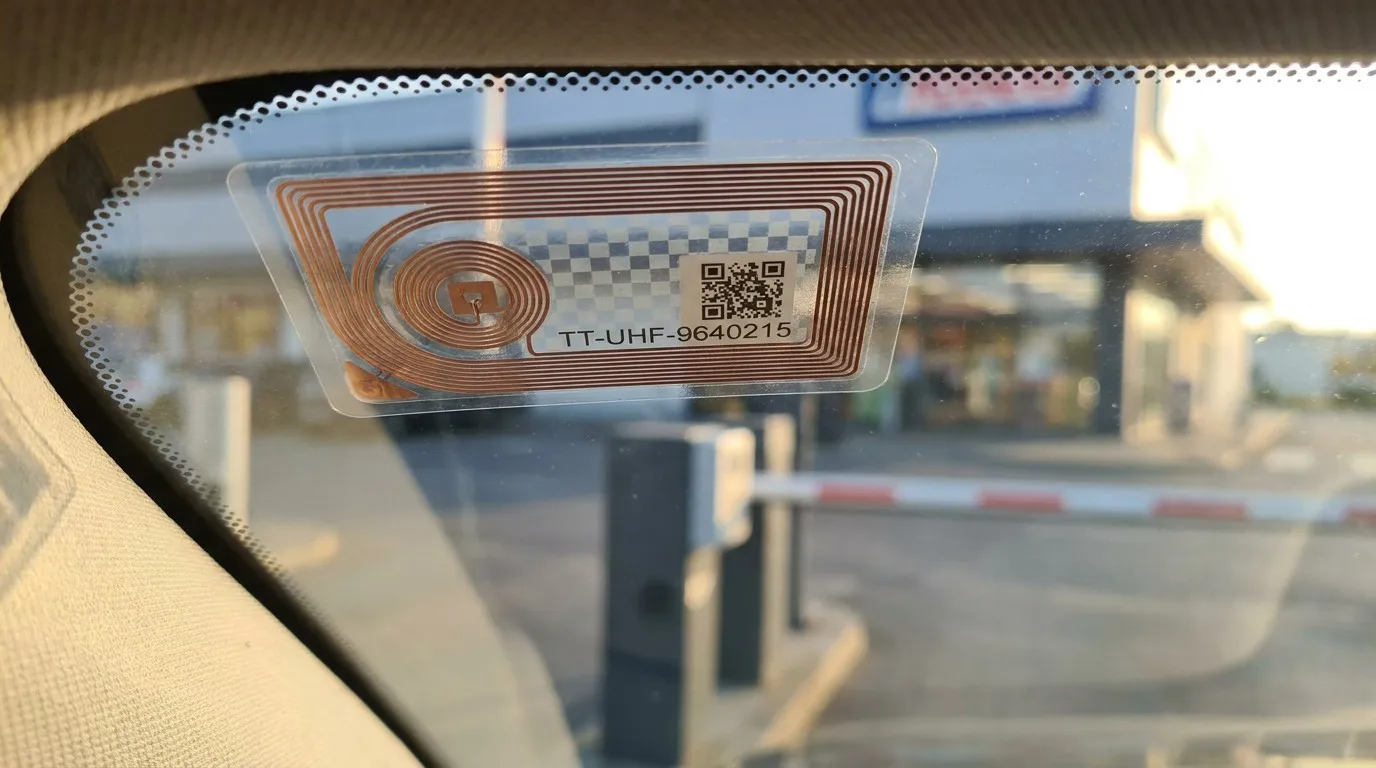
1. The Chip Landscape You Should Actually Care About
Ninety percent of the 2026 windshield-tag market runs on four silicon platforms. Anyone quoting you a “generic UHF chip” is quoting NOS (new-old-stock) or a rebranded knock-off. Ask for the wafer source by name:
| Chip | EPC Memory | User Memory | Sensitivity (Read) | Best For |
|---|---|---|---|---|
| Impinj Monza R6-P | 96 – 128 bit | 32 bit | −22.1 dBm | ETC, high-speed tolling |
| NXP UCODE 9 | 96 bit | 0 bit | −23 dBm | Dense parking, anti-collision |
| Alien Higgs-9 (H9) | 96 – 480 bit | 688 bit | −22.5 dBm | Fleet + serialized data logging |
| Impinj M750 | 128 bit | 32 bit | −22.6 dBm | Cost-optimized gated access |
Procurement note: If your operating environment includes heat-rejection windshields (common on 2020+ Toyota, Ford, and most EVs sold in North America), you must specify a chip with <- 22 dBm read sensitivity. Anything worse and the metallic infrared coating in the glass will kill your read rate below 60% — regardless of reader power.
2. Regional Frequency Bands: Get This Wrong, Import Gets Rejected
UHF is not one global band. If the tag is programmed and antenna-tuned for the wrong region, customs may hold the shipment (Egypt, India, Brazil all inspect for spectrum compliance now), or the tags will simply not read at your deployment site.
- FCC (US, Canada, Mexico, most of LATAM): 902–928 MHz
- ETSI (EU, UK, GCC, most of Africa): 865–868 MHz
- China SRRC: 920–925 MHz
- Japan ARIB: 916.7–920.9 MHz
- India WPC: 865–867 MHz
The physical antenna dipole length is different for each band. A “universal” tag exists, but you pay for it in read range — typically 30–40% shorter than a region-tuned tag. For projects above 5,000 units, always specify a region-locked SKU.
3. Four Form Factors, Four Very Different Cost Structures
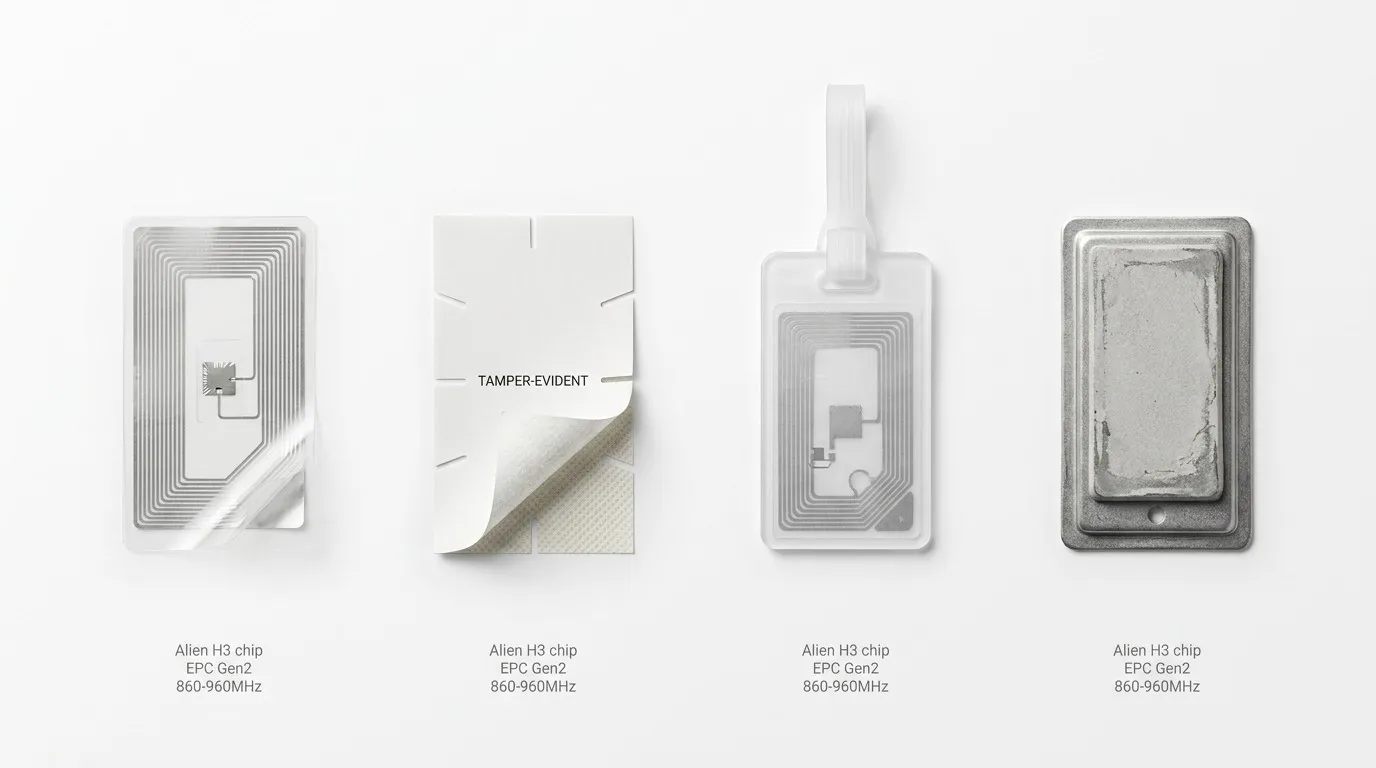
A. Transparent Polycarbonate Sticker (the ETC standard)
PC or PET substrate, silver-inked or copper-etched antenna, permanent acrylic adhesive with tamper-evident die-cut. Read range 6–10 m. Cost bracket: USD 0.28–0.55 per unit at 10K quantities. Used by essentially every national tolling authority in the world.
B. Paper Windshield Decal (VOID pattern)
Coated paper face-stock, weak-adhesive rear, tamper-evident residue pattern (“VOID” or checkerboard). Cheapest at USD 0.09–0.18 per unit, but the read range drops to 4–6 m, and the lifetime under UV is 18–24 months. Suitable for short-cycle programs (event parking, monthly parking permits).
C. Reusable Hang Tag
Rigid ABS or PC housing with a lanyard, meant to hang from the rearview mirror. Read range 5–8 m. USD 0.90–1.80 per unit. Popular in gated communities where residents rotate vehicles.
D. On-Metal Ceramic Hard Tag
For commercial fleets and construction vehicles, where the “windshield” is actually a steel canopy or the tag needs to survive high-pressure washing. USD 2.50–5.00 per unit, IP68, 10-year lifespan.
4. The Adhesive Problem Nobody Tells You About
Most tag failures in the field are not chip failures. They are adhesive failures. Three killers:
- Thermal cycling. A car parked in Phoenix in July can hit +82 °C on the interior windshield. Cheap adhesive delaminates in 90 days. Specify: 3M 467MP or equivalent acrylic, service range −40 °C to +150 °C.
- Windshield chemistry. Modern windshields use hydrophobic coatings (Rain-X-style OEM treatments) that reject silicone-based adhesives. Specify: solvent-primer-compatible acrylic.
- Removal of residue. If your program requires tag rotation (fleet reassignment, parking permit expiry), tamper-evident is not what you want — you want clean-release adhesive. These are two different SKUs. Do not confuse them.
5. Tamper-Evidence: Choose the Right Architecture
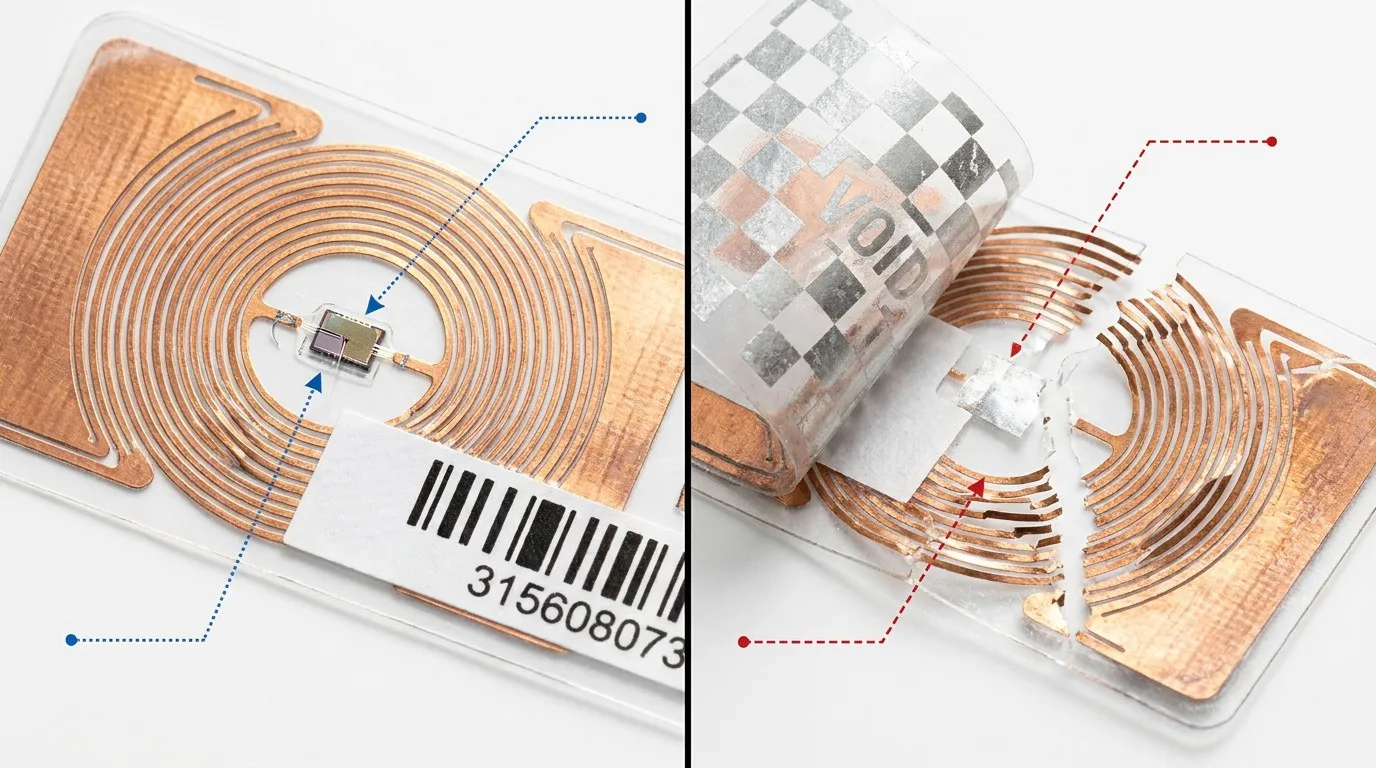
Three tamper-evidence architectures dominate the market. Each answers a different security threat:
- Die-cut antenna kill (irreversible). The antenna is fabricated across die-cut lines. Any peel attempt physically severs the antenna. Tag is dead — cannot be re-applied to another vehicle. This is the ETC-grade standard.
- VOID pattern (visual). Peeling leaves a printed “VOID” residue on the glass. The tag itself may still function, but visual inspection reveals tampering. Suitable for compliance auditing, not for automated systems.
- Frangible face-stock. The face material shatters on removal. Cheap and effective, but leaves shredded residue that annoys customers on vehicle resale.
For ETC and access-control systems where the tag itself is the credential, insist on a die-cut antenna kill. For permit-style deployments where a human auditor validates, the VOID pattern is 60% cheaper and does the job.
Product Spotlight: Sourcing UHF Windshield Tags from a Shenzhen Manufacturer
Toptag Group has been shipping UHF vehicle-identification hardware from our 5,000 m² Shenzhen facility since 2015. Our UHF RFID Tag Sticker line covers all four form factors described above, with Impinj, NXP, and Alien chip options in stock for FCC, ETSI, and China SRRC bands. Minimum order quantity is 500 pieces for stock SKUs and 3,000 pieces for custom-printed graphics. Full 100% pre-shipment read-rate testing is standard on all vehicle-tag orders — every tag is verified against a calibrated reader before boxing.
For the reader-side infrastructure, our Long Range UHF RFID Reader (0–5 m read range, ISO 18000-6C, Wiegand26/34 and TCP/IP interfaces, 30 dBm adjustable output) is the gantry-mount unit most of our parking and fleet customers deploy. Full SDK support in C#, Java, VB, and Delphi is included at no additional cost.
6. Deployment Scenarios and What Each One Actually Needs
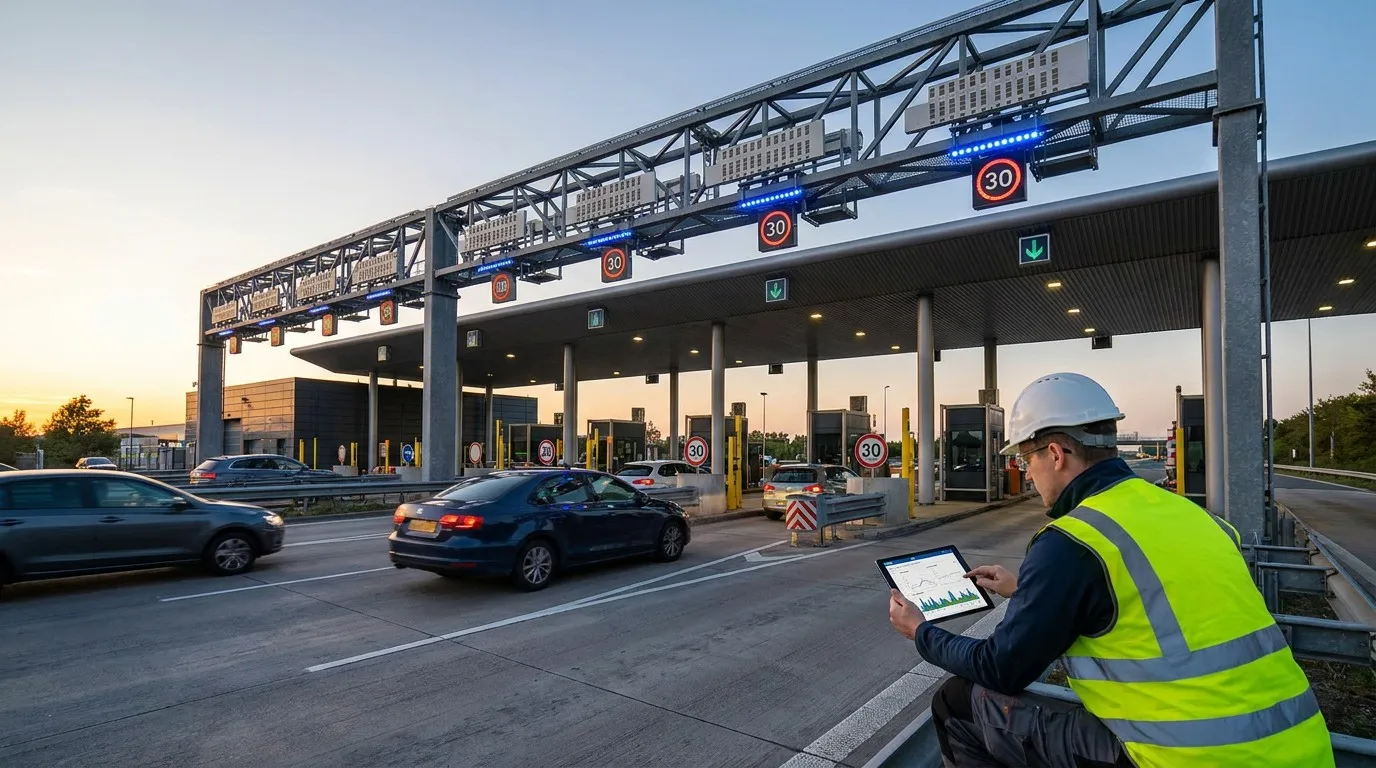
Electronic Toll Collection (ETC)
Speed profile: 30–120 km/h. Anti-collision requirement: 40+ tags/second. Mandatory spec: Impinj Monza R6-P or M750 chip, region-tuned antenna, die-cut tamper-evident, permanent adhesive. Expect 0.32–0.45 USD/tag at 100K+ quantities.
Gated Community / Residential Compound
Speed profile: 5–15 km/h. Volume: 200–3,000 vehicles per gate. Recommended: Impinj M750 chip on transparent PC substrate, or reusable hang tag for guest-vehicle programs. Reader mounting: a single overhead antenna is enough; no gantry required.
Corporate Campus Parking
Speed profile: 5–20 km/h. Special requirement: integration with the employee badge system. Recommendation: dual-frequency (UHF + 13.56 MHz HF) card that doubles as the office access badge. This eliminates the need to issue two credentials per employee.
Commercial Fleet Yard Management
Speed profile: 3–10 km/h, high dwell time. Environment: dust, weather, high-pressure wash. Spec: on-metal ceramic hard tag, IP68, permanent bolt or bond mount to the truck cab exterior — not the windshield.
Airport & Logistics Terminals
Speed profile: variable, mixed vehicle types (cars + trucks + shuttle buses). Requires a multi-height gantry (min. 2 antenna heights per lane) to catch both car and truck-cab windshield positions. Chip spec: NXP UCODE 9 for dense-population anti-collision.
7. Certification and Compliance Checklist for 2026
Do not sign an RFQ without these documents from your supplier:
- ISO/IEC 18000-63 (Class 1 Gen 2 UHF air-interface conformance)
- Regional radio approval: FCC Part 15 (US), CE RED (EU), SRRC (China), WPC (India), ANATEL (Brazil), ICASA (South Africa)
- RoHS 3 + REACH SVHC 2026 declaration (mandatory for EU import)
- GS1 EPC allocation letter if your program uses SGTIN-96 numbering
- HS Code 8523.52 for classification — this saves you 2–4% duty in most jurisdictions vs. the wrong 3919.90 self-adhesive-label code
8. Frequently Asked Questions from B2B Buyers
Q1: How do I sample-test a tag before placing a full production order?
Request 20–50 free samples with your project chip and adhesive spec, then test on three different windshield types (standard laminated, heat-rejection, and a sedan sunroof glass sample) using a reader in your actual deployment environment. Toptag ships free samples worldwide via DHL for verified B2B accounts.
Q2: What lead time should I expect for 50,000 units custom-printed?
Standard: 18–25 calendar days after artwork approval. Air-freight (5–7 days DHL/FedEx) or sea (25–35 days) shipping additional. Do not accept “10-day” quotes on 50K+ custom orders — that promise is almost always broken.
Q3: Can I encode my own EPC data before shipment?
Yes. Provide the EPC value list in CSV or JSON format and specify TID-based UID linkage if you need immutable serialization. The encoding fee is typically USD 0.02–0.04 per tag, waived at 20K+ quantities.
Q4: How do I handle mixed windshield types (some heat-rejection, some standard)?
Two options: (1) Deploy a single premium-spec tag across the whole fleet (higher unit cost, no logistics headache), or (2) SKU-split the deployment (lower per-tag cost, but requires tag-to-vehicle inventory tracking). For fleets under 5,000 vehicles, option 1 usually wins on total cost of ownership.
Q5: What is the realistic lifetime of a windshield tag?
Transparent PC sticker with die-cut tamper-evidence: 5–7 years under normal automotive UV exposure. Paper decal: 18–24 months. Ceramic hard tag: 10+ years. Warranty terms vary — ask specifically.
Q6: Can these tags be read from outside the vehicle if applied inside?
Yes. That is the entire point of windshield placement. The reader antenna sits above or beside the lane and reads through the glass. Placement on the interior avoids weather exposure and tampering while maintaining full read performance.
Q7: What if the customer wants to remove the tag?
With die-cut tamper-evident construction, removal destroys the tag. Provide a written removal procedure to end-users: apply isopropyl alcohol along the edge, wait 2 minutes, peel slowly. Any adhesive residue on the glass can be cleaned with a plastic razor blade.
Q8: How do I integrate the read events with my existing parking/access-control software?
Toptag’s UHF readers output over Wiegand 26/34 (drop-in replacement for most access-control panels), RS-232/485 (industrial systems), and TCP/IP with a documented JSON API. Reference integrations exist for Genetec, Milestone, Nedap, and most open-source platforms.
Q9: Do customs treat these as electronics or as labels?
HS Code 8523.52 (Smart cards / RFID) is the correct classification. Some suppliers ship under 3919.90 (self-adhesive labels), which is cheaper on paper but often triggers a customs re-classification and back-duty bill. Always insist on 8523.52.
Q10: Is there a way to lower per-unit cost without sacrificing performance?
Three levers: (1) Order region-locked instead of universal antenna — 20% cost reduction. (2) Use M750 instead of Monza R6-P where read distance is under 4 m — 15% reduction. (3) Standardize on one adhesive class across all deployment climates — 5–8% BoM savings. Combined, a well-optimized RFQ delivers 30% lower unit cost than a first-time buyer usually pays.
Request Samples
Get free UHF windshield tag samples with your chip and adhesive spec. Toptag Group ships free samples worldwide to verified B2B accounts. Include your target frequency band, expected annual volume, and windshield type in your inquiry — we will ship samples optimized for your actual deployment environment.
- 📧 Email: [email protected]
- 💬 WhatsApp: +852 5989 6589
- 🟢 WeChat: 147891664
- 🔗 Contact page: https://www.toptaggroup.com/contact-us/
Published July 2026. All product specifications are subject to periodic revision — request the latest datasheet at the time of quote.