


134.2KHz Microchip Scanner W91A: handheld FDX-B ISO 11784/85 ring reader, USB or Bluetooth, TFT display, 500 records. MOQ 1 pcs, samples 5-7 days.
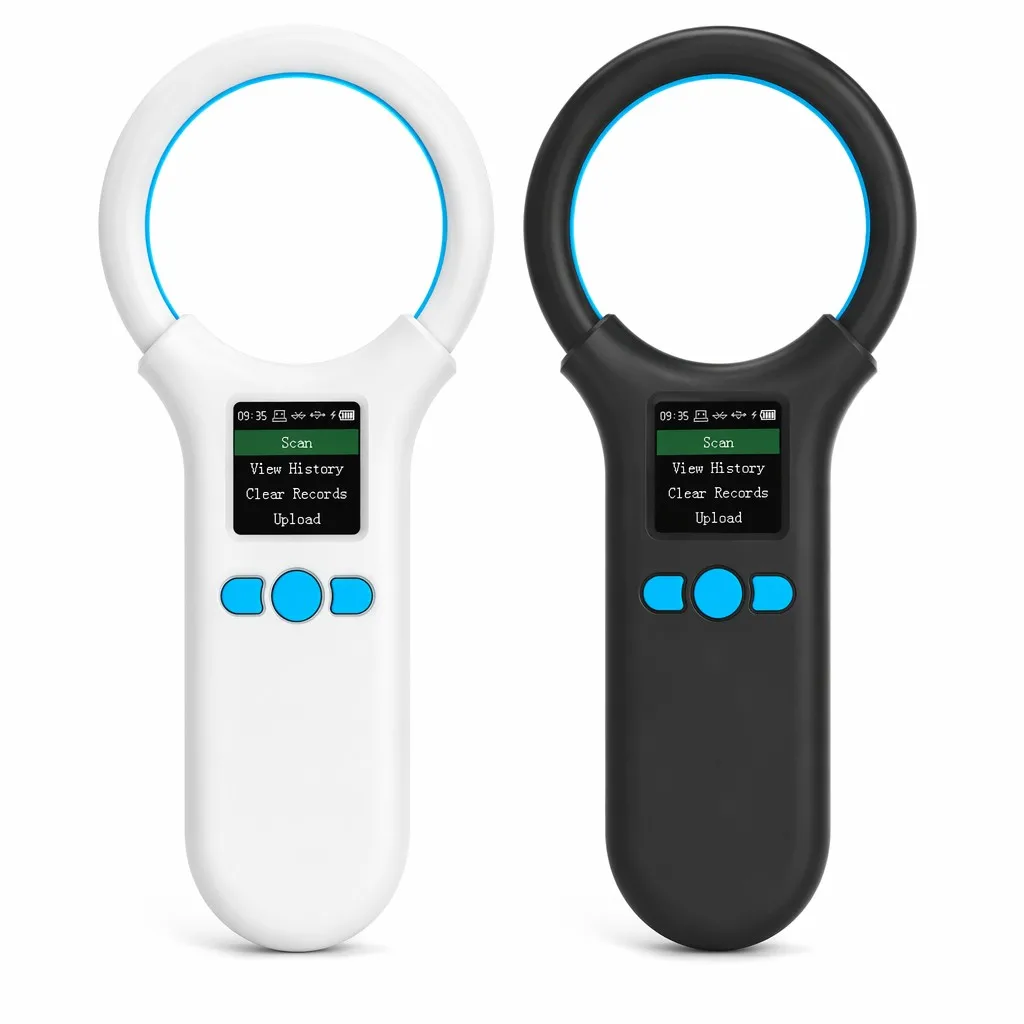
134.2KHz Microchip Scanner W91A is a handheld ring-loop reader that decodes FDX-B / EMID transponders under ISO 11784/11785 in under 100 ms, ships in a wired (USB 2.0 + 2.4 GHz dongle) or wireless (Bluetooth 4.2) variant on the same chassis, and stores 500 scanned IDs offline for later upload to a PC or cloud herd-management platform. This page is a decision guide: it compares the wired and wireless variants of the 134.2KHz Microchip Scanner head-to-head, tells you when each variant makes economic sense, and shows where the W91A fits between the entry-level W86 stick reader and the pro-tier W90C Bluetooth scanner that we also produce.
The Landscape — What Options a Vet or Rancher Actually Has Today
Anyone buying a handheld 134.2 kHz animal microchip reader in 2026 sees three price tiers on Alibaba. At the bottom is a $15–25 “stick reader” (typically a W86 or clone) that reads FDX-B under ISO 11784/85 and blinks a red LED — no screen, no memory, no wireless. In the middle is a $35–65 ring-loop scanner with a small LCD or TFT screen and 100–500 records of internal memory — the category the W91A belongs to. At the top is a $120–200 “professional” Bluetooth reader with cloud-sync APIs and rugged IP67 housings, typically bought by government veterinary services or large integrator projects. The 134.2KHz Microchip Scanner W91A sits deliberately in the middle tier because that is where 80% of real-world buyers actually live: independent vets, small-to-medium ranchers, pet shelters, and mobile veterinary units who need a screen, memory, and wireless upload — but who do not need or want to pay for the top-tier features they will never use. Manufactured on a Shenzhen production floor operating since 2008 with 5 dedicated production lines and 200+ skilled workers producing RFID readers, cards, keyfobs, and 134.2 kHz ICAR-compliant animal microchips under one roof.
W91A Wired vs W91A Wireless — Head-to-Head
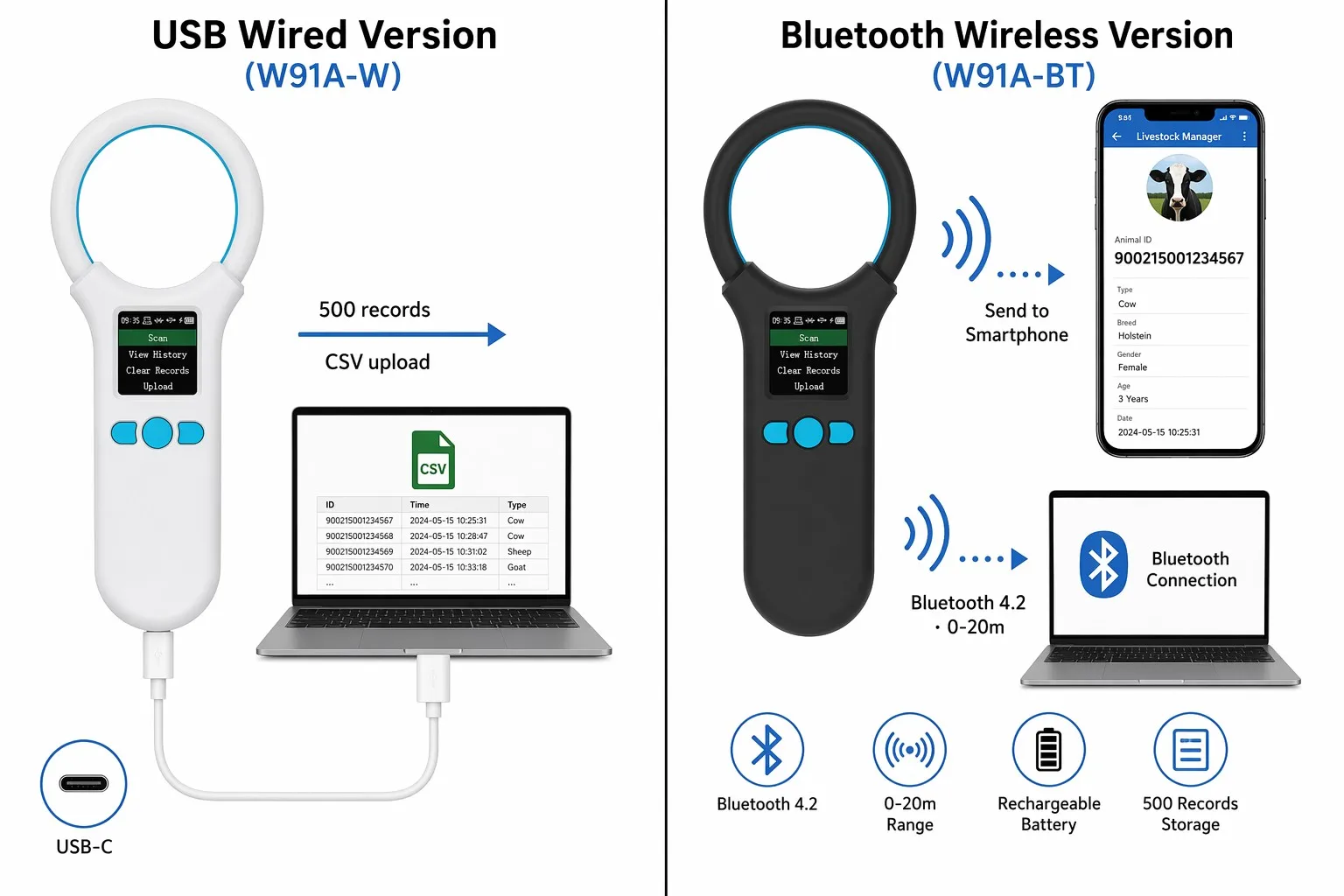
The 134.2KHz Microchip Scanner ships in two SKU variants on the same hardware chassis. The only differences are the communications module and the price point. Everything mechanical and every animal-reading specification is identical.
| Parameter | W91A Wired (USB + 2.4 GHz) | W91A Wireless (Bluetooth 4.2) |
|---|---|---|
| Model | W91A-W | W91A-BT |
| Operating frequency | 134.2 kHz / 125 kHz (dual) | 134.2 kHz / 125 kHz (dual) |
| Tag protocols read | FDX-B (ISO 11784/85), EMID | FDX-B (ISO 11784/85), EMID |
| Read distance — 2×12 mm glass microchip | >8 cm | >8 cm |
| Read distance — 30 mm ear tag | >20 cm | >20 cm |
| Read time | <100 ms | <100 ms |
| Display | 1.44″ colour TFT | 1.44″ colour TFT |
| Buttons | 3 capsule (Scan / Menu / Enter) | 3 capsule (Scan / Menu / Enter) |
| Internal storage | 500 records | 500 records |
| PC interface | USB 2.0 cable + 2.4 GHz USB dongle | USB 2.0 cable (charge only) |
| Wireless communication | 2.4 GHz proprietary, 0–80 m LOS | Bluetooth 4.2 SPP + BLE, 0–20 m LOS |
| Pairs with smartphone | No (dongle → PC only) | Yes (Android + iOS) |
| Battery | 3.7 V 800 mAh Li-Ion | 3.7 V 800 mAh Li-Ion |
| Continuous scan life | ~18 h | ~14 h (BT on) |
| Operating temperature | –10 °C to +50 °C | –10 °C to +50 °C |
| Storage temperature | –30 °C to +70 °C | –30 °C to +70 °C |
| Humidity | 5%–95% non-condensing | 5%–95% non-condensing |
| Dimensions | 182 × 82 × 17.5 mm | 182 × 82 × 17.5 mm |
| Net weight | 78 g | 78 g |
| Housing colour | Black or White | Black or White |
| Language | English default (custom on request) | English default (custom on request) |
| Certifications | CE / FCC / RoHS / ISO 9001:2015 | CE / FCC / RoHS / ISO 9001:2015 + Bluetooth SIG |
When to Choose W91A Wired Over W91A Wireless
Choose the wired variant when the reader spends most of its life on a specific workstation: a vet clinic’s exam-room bench, a slaughterhouse chute-side station, a customs inspection desk, a shelter’s admissions kiosk. In these settings a USB cable simply plugs into a Windows / macOS / Linux host and the 134.2KHz Microchip Scanner appears as a HID keyboard — every scanned ID types straight into whatever software field has focus (Vetport, ezyVet, IDEXX Cornerstone, PetLink, or a plain Excel spreadsheet). No pairing, no driver installation, no batteries to babysit. The wired variant also ships with a 2.4 GHz USB dongle for cases where the vet wants to scan a Great Dane on the floor across the room without unplugging — but the primary use case is deskbound. Wired is roughly 15% cheaper than Bluetooth at MOQ, which matters when a shelter is buying 20 units for its intake staff.
When to Choose W91A Wireless Over W91A Wired
Choose the wireless variant when the reader travels: a large-animal vet driving between farms, a mobile shelter clinic, a customs officer sweeping a batch of imported pets at an airport terminal, a livestock inspector walking a barn. Bluetooth 4.2 SPP + BLE pairs directly with Android and iOS smartphones running any of the standard herd-management apps (Cattlelinks, HerdPortal, FarmVet, PetLink mobile), and once paired the 134.2KHz Microchip Scanner streams every scanned ID straight into the app for real-time cloud upload. The 20 m Bluetooth range is deliberately smaller than the 80 m 2.4 GHz range of the wired variant because Bluetooth trades range for battery efficiency and cross-platform compatibility. In practice, 20 m is more than enough — the operator is holding the phone in the same pocket the scanner is aimed from.
When NOT to Choose W91A At All
Honest guidance saves everyone time. Do not buy the W91A if any of the following describe your project:
- You need to read UHF (860–960 MHz) ear tags on cattle at a chute-side portal. The 134.2KHz Microchip Scanner is LF-only; UHF is a different frequency band, different protocol (EPC Gen2), and requires a different reader class (Impinj R700, Zebra FX9600, Feig LRU3000). We build UHF readers separately — ask for the long-range UHF SKU.
- You need IP67 rugged housing for outdoor use in rain or wash-down environments. The W91A is IP54 splash-resistant, which handles barn dust and light drizzle but is not designed for pressure-washing or sustained rain. For IP67 field work look at the pro-tier scanners at 2–3× the price.
- You only need to identify a single pet occasionally. If you scan 5 chips a month, a $20 stick reader is the right economic choice — the W91A’s screen, memory, and wireless upload are wasted budget for that volume. Buy a 134.2KHz W86 Reader instead.
- You need a proximity-only “gate” reader mounted on a wall. Handheld scanners are handheld; fixed installations need a different mechanical form.
Technical Deep-Dive on the W91A Reader Front End
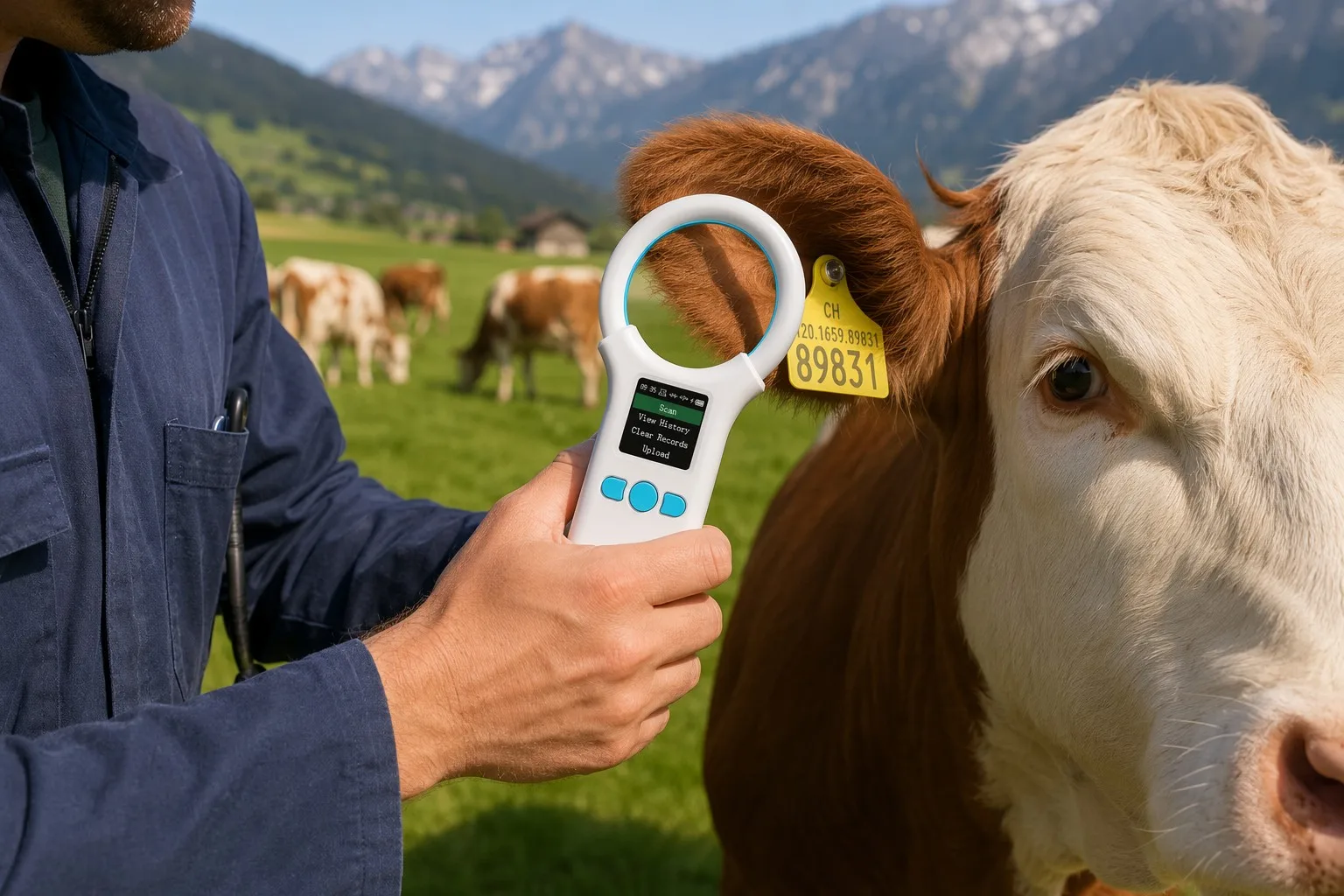
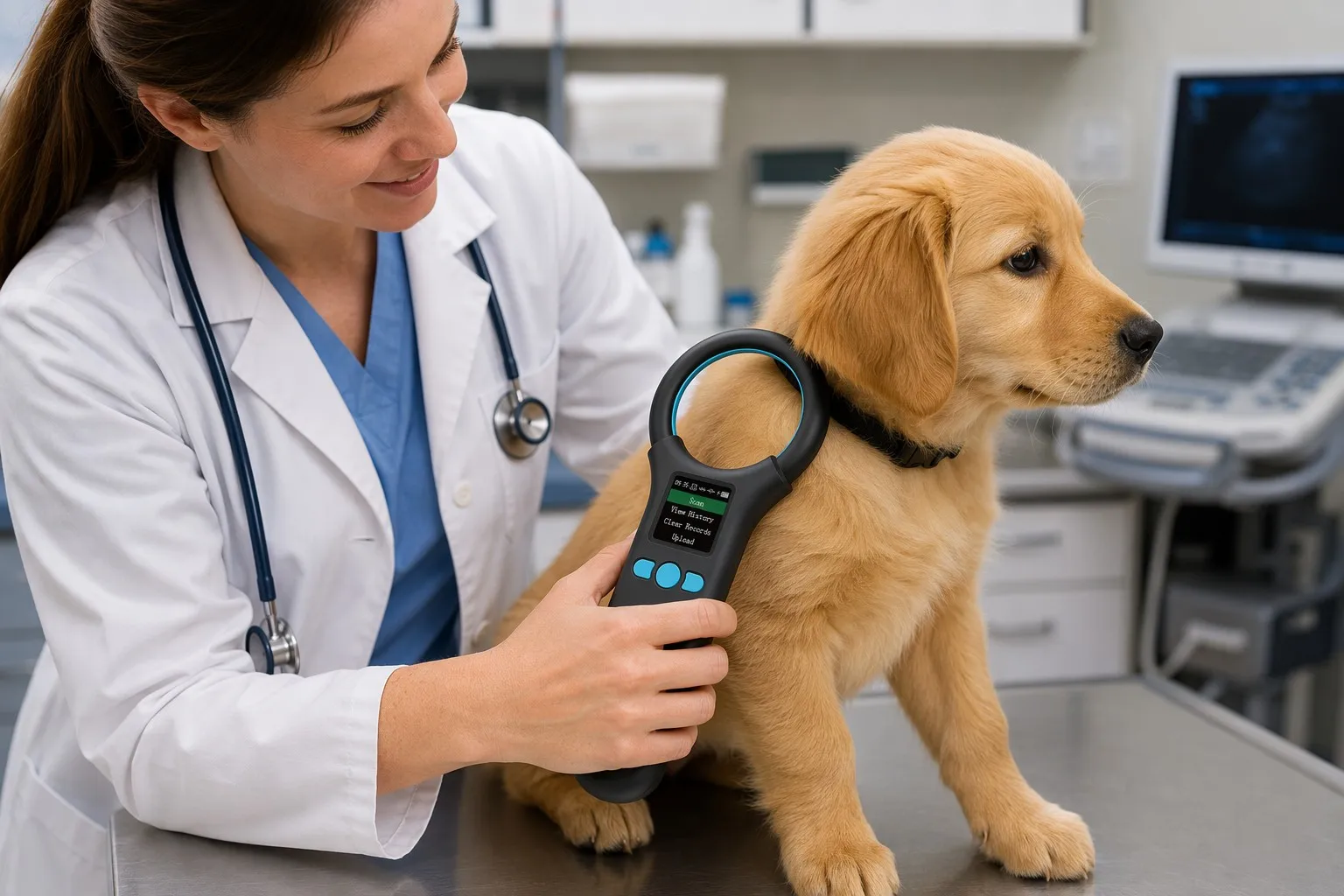
The 134.2KHz Microchip Scanner uses a large ring-loop antenna (≈90 mm outer diameter) tuned to 134.2 kHz for FDX-B ISO 11784/11785 half-duplex telegrams and simultaneously to 125 kHz for legacy EMID (unique-ID-only) transponders. The dual-frequency front end auto-detects which protocol the transponder is speaking within a 100 ms sampling window, so operators do not need to toggle modes. The large ring loop is the key to the >20 cm read distance on 30 mm cattle ear tags — a stick reader with a small coil physically cannot generate a big enough near-field to energise a 30 mm tag beyond 10 cm. For 2×12 mm ISO-standard glass tube microchips (the size implanted under a dog or cat’s shoulder skin), rated read distance is >8 cm from the tag’s long axis; in practice most operators read at 3–5 cm because that is where they hold the ring near the animal. The 1.44-inch colour TFT display renders the 15-digit ISO ID with a species-country prefix so the operator can visually verify before uploading.
Firmware Features That Actually Matter in the Field
- 500-record offline memory. Each scan stores timestamp + 15-digit ID + optional 32-byte note field. When the vet returns to the truck or clinic, all 500 records are uploaded to CSV or JSON via USB or Bluetooth in under 3 seconds.
- Duplicate-scan suppression. If the same tag is scanned twice within a configurable window (default 5 seconds), the second scan is suppressed — useful when a cow shakes her head and re-enters the read zone.
- Buzzer + vibration feedback. Both modes are togglable independently; a shelter working late at night can suppress the buzzer and rely on vibration only.
- Firmware upgradeable via USB. Field updates delivered as a small binary file; upgrade takes under 30 seconds.
- Custom language pack. English is default; French, Spanish, Portuguese, German, Turkish, and Russian language packs shipped on request at no additional cost for orders above MOQ.
Manufacturing & QC
Every W91A ships through a five-stage QC gate on our Shenzhen production line: (1) SMT AOI (automated optical inspection) on the reader-board sub-assembly; (2) 100% cavity-level read test using ICAR-compliant reference transponders at 8 cm, 15 cm, and 25 cm distances to confirm rated read range; (3) battery burn-in for 24 hours at 100% duty cycle to weed out early-failure Li-Ion cells; (4) Bluetooth SIG-compliant pairing test (Bluetooth variant only) against a reference Android device; (5) final visual and functional cross-check with the scanned-ID serial logged into the batch CSV before packing. Batch traceability is preserved end-to-end: the last four digits of the reader’s IMEI-equivalent hardware ID map back to the production batch CSV for warranty-return diagnostics.
5 Questions to Ask Before Ordering
- What is the primary transponder you need to read? If it is ISO 11784/11785 FDX-B (the global standard for microchips implanted in pets and livestock), the W91A is the right reader. If it is UHF EPC Gen2 or HF 13.56 MHz, this is not your product.
- Wired or wireless? Deskbound clinic → wired. Mobile vet or livestock inspector → wireless. Answer 5-second question 1 above and this one becomes obvious.
- How many records between uploads? A vet doing 20 scans a day fits comfortably inside 500-record memory over 25 days. A large livestock inspection doing 300 scans in a morning needs to upload before lunch — plan the workflow accordingly.
- What is the target volume? MOQ is 1 unit on the standard W91A because the 134.2KHz Microchip Scanner is device-class hardware, not consumable RFID media — you can order a single unit for evaluation, a 10-unit deployment for a mid-size shelter, or 500 units for a national livestock programme, all off the same catalogue. Custom colour or firmware branding starts at MOQ 100 pcs. Custom OEM mould starts at MOQ 500 pcs and adds 25–35 days to lead time.
- Do you need Chinese New Year buffer? Orders placed in December for January delivery must add 30–40 days to standard lead time because our factory closes for the Spring Festival holiday. Plan Q4 procurement accordingly.
Ecosystem Compatibility
The 134.2KHz Microchip Scanner W91A is verified to work with the following software and hardware ecosystems out of the box: Vetport, ezyVet, IDEXX Cornerstone, PetLink, HomeAgain, AVID PETrac, 24PetWatch (via manual ID entry from the display), Cattlelinks, HerdPortal, FarmVet, Cargill Cattle Trace, and any generic Windows / macOS / Linux app accepting HID-keyboard input. Bluetooth 4.2 SPP + BLE profile means it pairs with any Android 6.0+ or iOS 12+ smartphone; developers get a documented serial-over-BLE protocol on request for building custom herd-management apps. We keep a compatibility test lab in Shenzhen running 40+ target host systems continuously — if your specific back-end is not listed, ship us the target SDK and we will validate compatibility at no charge before your PO.
How the W91A Compares to Our Own W86 and W90C
We manufacture three handheld animal microchip scanners in parallel because different budgets and use cases need different tools. The W86 Reader is our entry-level LCD stick reader — no ring loop, no wireless, ~10 cm max read distance on ear tags; the right choice for a low-scan-volume clinic that needs to identify one pet at a time. The W91A (this page) is the mid-tier ring-loop scanner with TFT screen, 500-record memory, and wired-or-wireless choice. The W90C Scanner is the top-tier variant with a larger 2.4-inch TFT, expanded 1,000-record memory, and simultaneous Bluetooth + 2.4 GHz radios — for large livestock projects where the vet cannot afford to switch between wired and wireless SKUs mid-day. All three share the same ICAR-compliant reader front end, the same 134.2 kHz / 125 kHz dual frequency, and the same accessories (chargers, dongles, USB cables) — so an operation can start with W86 and upgrade selectively without stranding investment.
Order & Sample
MOQ is 1 unit on standard W91A-W or W91A-BT (black or white housing, English firmware). Because the 134.2KHz Microchip Scanner is device-class hardware with a real bill-of-materials cost — Li-Ion battery, TFT display, Bluetooth SIG-certified radio module, injection-moulded ABS ring housing, and per-unit ICAR-compliant read-range calibration on the factory line — we do not ship free samples on this SKU. Instead, buyers place a paid evaluation-unit order at standard catalogue price with 5–7 business day dispatch via DHL or FedEx; the paid sample is fully credited against any production PO placed within 60 days. This is standard practice across the RFID reader industry and reflects the same cost structure as our W90C and W86 handheld readers. Custom OEM projects (private-label housing, custom firmware boot screen, custom language pack, or custom mould) supported at MOQ 100 / 500 / 500 respectively. Standard payment terms: T/T 30% deposit + 70% before shipment; Alibaba Trade Assurance available through our xinxingsmart / Jingzhou Syntek Smart store; PayPal accepted up to $5,000. Shipping incoterms EXW, FOB Shenzhen or Hong Kong, CIF, or DDP quoted per destination country at RFQ. HS Code 8471.60 for smooth customs clearance in every major market (RFID reader / automatic data-processing input device classification per US CBP ruling N261411).
FAQ
Q1: Does the 134.2KHz Microchip Scanner read HDX or half-duplex-B only?
The W91A reads FDX-B (Full-Duplex-B) under ISO 11784/11785 — the global standard for pet and livestock microchips. It does not read HDX (Half-Duplex) transponders, which are a separate ISO 11785 variant used mainly in Australian and New Zealand livestock. If you need HDX support, tell us at RFQ and we will quote the W90C-HDX firmware variant instead.
Q2: Is the W91A ICAR-approved?
The scanner is ISO 11784/11785 compliant and reads all ICAR-registered manufacturer codes correctly, but the W91A itself is not on the ICAR-approved reader list because ICAR listing requires a per-model fee that is not economic for a mid-tier scanner. If ICAR listing is a hard procurement requirement for your project (some government veterinary tenders demand it), specify the W90C at RFQ — it is our ICAR-listed variant.
Q3: Can I get custom firmware or a custom boot logo?
Yes. Custom boot-screen logo and custom idle-screen graphics are free at MOQ 500. Custom firmware features (custom serial-output format, custom Bluetooth device name, custom duplicate-suppression window) supported at MOQ 500 with a one-time engineering fee scoped per project. Custom language pack (French, Spanish, Portuguese, German, Russian, Turkish, or others) supplied at no charge for orders above MOQ.
Q4: What is in the box?
Standard packing per unit: W91A scanner, USB Type-C charging cable, 2.4 GHz USB dongle (wired SKU only), one-page multilingual quick-start guide, and a soft carry pouch. Master carton is 50 units at approximately 8 kg, palletised on standard Euro or Asia-Pacific pallets. HS Code 8471.60 printed on the commercial invoice (US HTSUS 8471.60.9050 per CBP ruling N261411 for RFID tag readers).
Get Your W91A Quote Started
Tell us four things and we will quote inside one business day: (1) wired W91A-W or wireless W91A-BT, (2) target volume (single unit is fine — MOQ is 1), (3) housing colour (black or white default; custom Pantone at MOQ 100), (4) English default firmware or custom language pack. Paid single-unit evaluation samples ship in 5–7 business days at catalogue price, fully credited against production PO placed within 60 days.
- Email: [email protected]
- WhatsApp: +852 5989 6589
- WeChat: 147891664


