
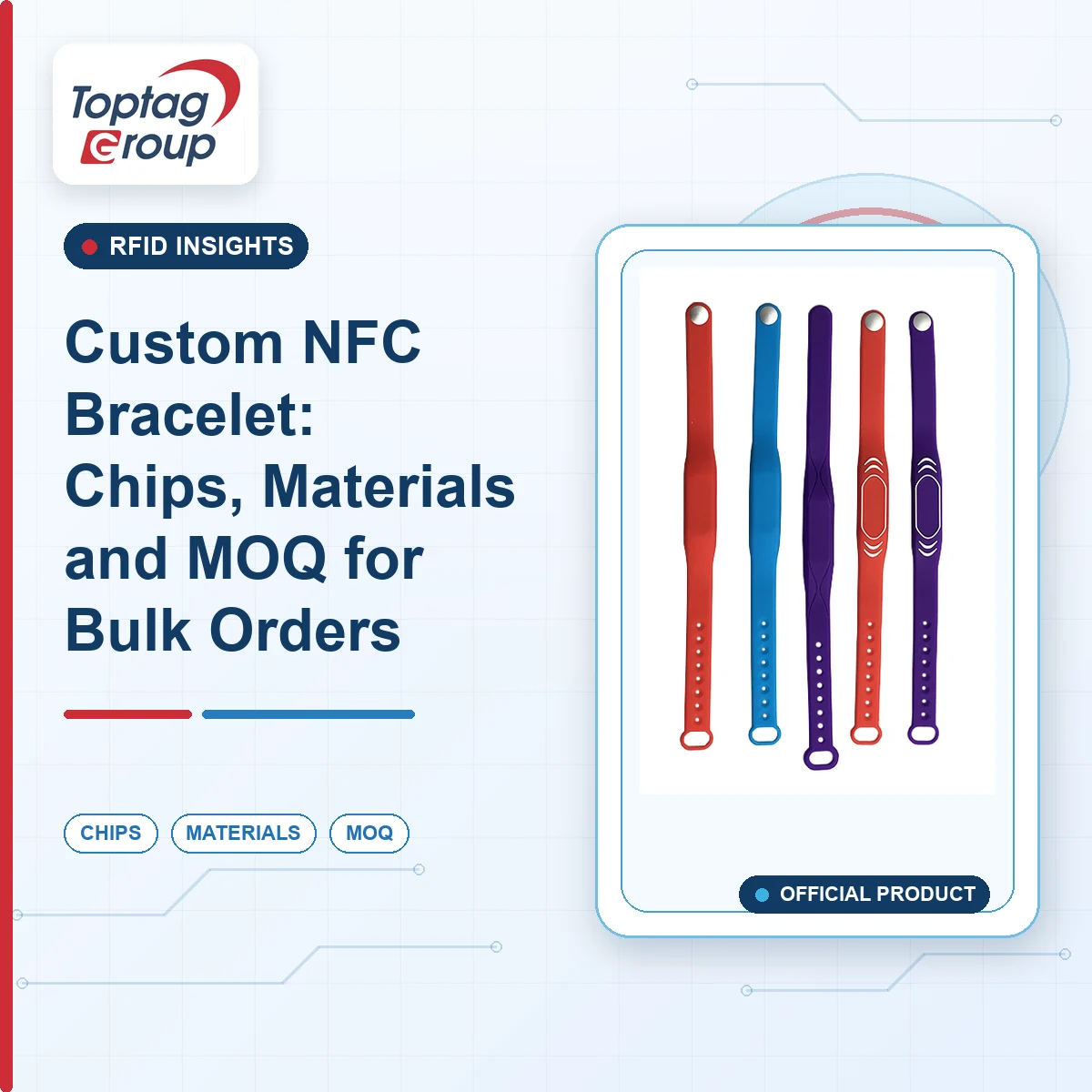
A promotional products distributor in the Netherlands told us about a summer campaign that went sideways. He ordered 3,000 custom NFC bracelets for a music festival, and when the boxes arrived, the chips held too little memory for the link bundle the marketing team wanted, and the logo print rubbed off within a week. The custom NFC bracelet they had in mind was a wearable promo piece, but the order had been quoted like a plain RFID band. The fix was not a cheaper supplier, but sorting the chip, material and print finish before deposit. This guide walks through what to check when you order a custom NFC bracelet in bulk: chip memory, band material, logo customization, encoding, MOQ and the sample test that catches problems early.
What a Custom NFC Bracelet Is Used For
A custom NFC bracelet sits on the wrist and reads when a compatible smartphone taps near the chip. Unlike an access-control wristband that opens a door or turnstile, this one carries a tap-to-share payload: a social profile, a digital business card, a landing page, a promo code or a wedding guest-book entry. It works as brand merchandise, a corporate networking accessory, a wedding favor, a fitness club giveaway or a retail loyalty piece.
Every custom NFC bracelet in a bulk run should match what the wearer does with it. One short link needs a small-memory chip; a contact card, several social handles and a coupon changes the choice. A paper card gets filed away; a worn band stays on the wrist and can be tapped again at the checkout or the next event.
Chip Choice: NTAG213, 215 and 216
The chip inside a custom NFC bracelet runs at 13.56MHz, the frequency a phone’s NFC antenna listens to. A distributor in Germany once ordered 5,000 reusable bands, and half the phones could not read them: the factory had shipped 125kHz chips, which talk to access readers, not a phone. Tap-to-phone use needs a 13.56MHz NFC chip.
Memory is where most buyers get caught. NTAG213 gives roughly 144 bytes, enough for one URL or a short contact record. NTAG215 holds around 504 bytes, and NTAG216 reaches roughly 888 bytes for several links or a small application pair. A cheap custom NFC bracelet with the wrong chip looks identical on the wrist, but the tap fails the moment the payload grows. Ask whether the chip stays rewritable after delivery or gets locked at encoding, and whether each band can carry a unique UID or printed serial number for inventory and loyalty tracking. Our custom NFC tag guide breaks down the same chip memory trade-offs for flat tags, and the logic carries over to bands.
Materials, Fit and Finish
The body of a custom NFC bracelet decides comfort, waterproofing and how long the logo survives. Silicone is the most common: soft, waterproof, easy to wipe, available in molded colors. PVC leans disposable or medical, thinner and cheaper for short campaigns. Fabric or woven nylon gives a premium look with a metal clasp; PU or leather-like finishes suit corporate and fashion lines.
Most custom NFC bracelet orders are stretch bands or adjustable clasp bands. Check the wrist size range before quoting: a band that fits a 150mm wrist will not please a 210mm one. Consider skin sensitivity for all-day wear, and the environment: beach, pool or sauna use calls for sealed silicone, not a moisture-holding fabric strap. Screen and pad printing sit on the surface and can wear on curved silicone; laser engraving or debossing lasts longer. Pantone matching on molded silicone often carries a higher MOQ than a stock color with a print.
Customization and Encoding Before Delivery
When you order a custom NFC bracelet, the artwork and the chip data are two separate workstreams. The logo needs a vector file, a color proof and a physical sample before the bulk run, especially on a curved surface where a flat design warps. The encoding needs the actual destination: a link, a social profile, a vCard, an email or a coupon code. Decide early whether each band carries the same payload or a unique one, and whether the data should be locked once written.
Consistency is the hidden risk in bulk encoding. Five thousand bands with five hundred miswritten links are hard to sort after packing. Test one iPhone and one Android phone before shipment, tapping a sample from several cartons. For member or access tracking, ask for serialized UID numbers matched to a spreadsheet. Our NFC tag supplier guide covers the encoding and factory checks that apply whether the product is a tag or a band.
MOQ, Pricing and Samples for Bulk Orders
A custom NFC bracelet quote splits into three parts: the blank band, the logo customization, and the per-unit encoding. MOQ depends on the route. Stock colors with a printed logo commonly open at 100 to 500 units. A molded color, custom size or new clasp pushes MOQ toward 1,000 units, because the supplier mixes material or sets up tooling. Encoding adds a small per-unit fee, and serialized data another step, so ask for both in writing.
A custom NFC bracelet with a molded Pantone color carries a molding lead time a printed stock-color band does not. One US brand learned this on a 500-unit rush order: the molded corporate shade needed fifteen days, so they switched to a stock band with a logo print and met the date. Always request a physical sample with the actual logo and encoded payload, not a blank demo band. Check clasp feel, print adhesion and tap speed on your own phone before approving production.
Quick Answers Before You Order
Can the bracelet be reused? Rewritable chips can be tapped and rewritten until locked. Once the payload is locked, the content stays fixed.
What is the minimum order quantity? It depends on material and finish. Printed stock-color bands start lower; molded colors, custom sizes and new clasps need a larger run.
Does it work with iPhones? Modern iPhones read 13.56MHz NFC tags in the background, no app required to open a link. Older devices vary, so test on a real iPhone in the sample stage.
How long does the logo last? Surface print wears faster on curved silicone than engraving or debossing. Pick the finish to match the campaign wear life.
Can it store a payment? The chip alone cannot hold a balance. Any payment use needs a compatible payment system and account on the reader side.
Is it waterproof? Silicone bands handle rain and washing easily. Fabric and leather-like finishes do not, so state the wet environment in the quote.
Send the use case, quantity, chip payload, material, logo artwork and any certification target through our inquiry page, and we will match chip, finish and MOQ before you commit to a bulk run.