
A festival organizer in the Netherlands told us about a gate problem he still brings up a year later. He ordered 8,000 QR-code paper bands for a three-day music event. At the main entrance, attendees held their phones up in the dusk, the code would not scan in poor light, and the queue backed up for nearly 40 minutes. The fix was not a faster scanner. It was switching the entry pass to an NFC wristband that a phone can read with a light tap, no camera alignment needed.
That case shows why buyers now ask about an NFC wristband early in planning. This guide covers the checks we run before a bulk order: chip compatibility, material, reuse, use case, customization, sample testing, and supplier support.
Chip and smartphone compatibility
The check most people skip is the chip. A modern NFC wristband works at 13.56MHz, the same frequency used by NFC tags in posters and cards. The chip decides what the band can do. NTAG213 gives about 144 bytes of user memory, enough for one link, contact record, or small event page. NTAG215 holds around 504 bytes, and NTAG216 reaches roughly 888 bytes for more text, several links, or a small application pair.
A distributor in Germany ordered 5,000 reusable silicone bands once, and half the phones on site could not open the tag. The supplier had shipped 125kHz chips. That frequency talks to dedicated access readers, not a phone’s NFC antenna. If your goal is tap-to-phone interaction, an NFC wristband has to carry a 13.56MHz NFC chip, not an LF proxy chip.
Ask for the exact chip model and a datasheet, and test it on both Android and iPhone before bulk production. NFC support varies by phone generation, so check several handsets.
Material, closure, and reuse
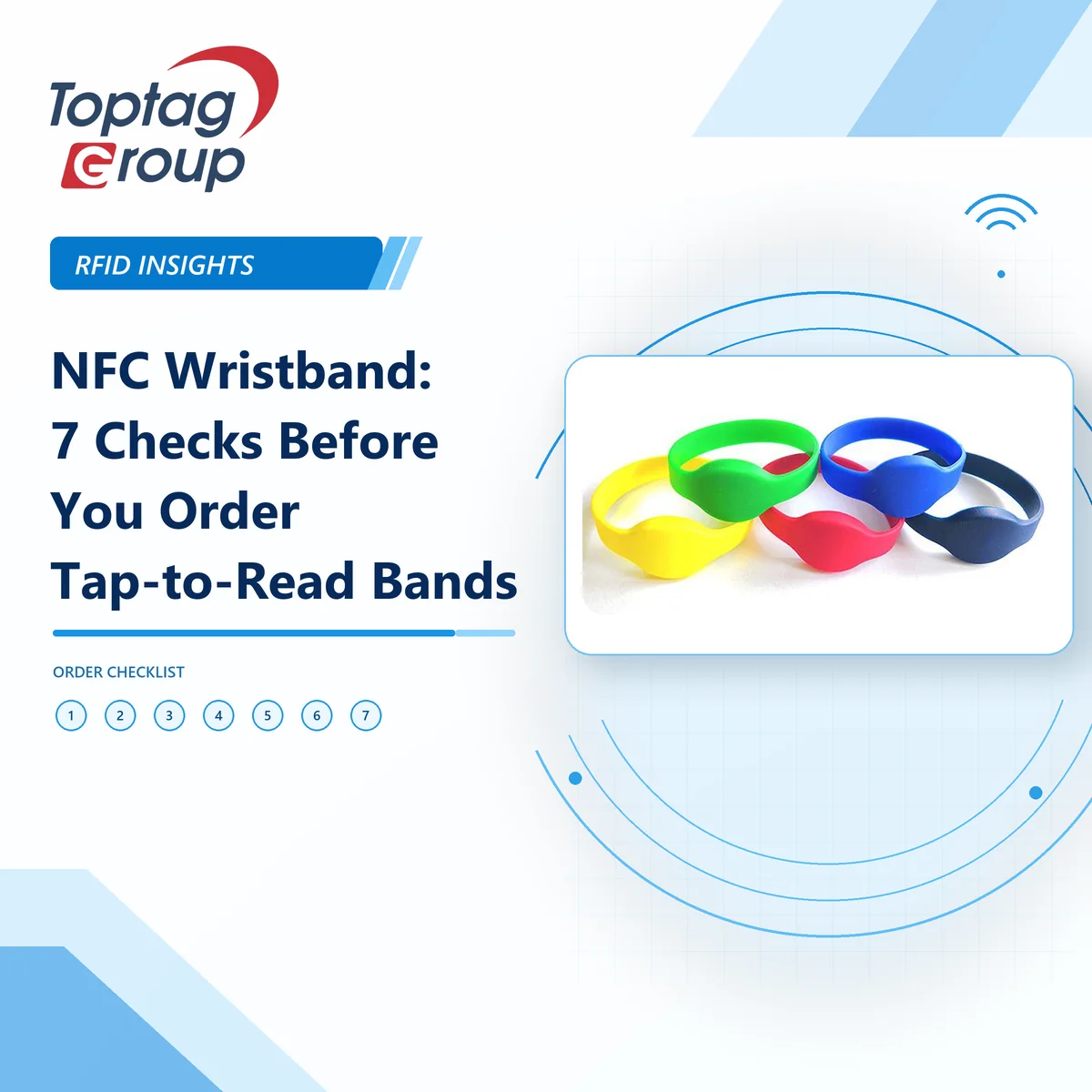
Silicone is the common choice for an NFC wristband worn more than once. It resists sweat, repeated washing, and light rain, and survives gym sessions, poolside stays, and multi-day events. PVC works for disposable medical or venue bands, while woven fabric feels lighter for festivals but needs a clean sealed edge or it frays.
Waterproofing matters more than buyers expect. A band worn at a pool resort, in a sauna, or outdoors in rain spends most of its life wet. The antenna and chip have to be sealed inside the material, not glued on the outside. For a reusable membership NFC wristband, a one-piece silicone construction also stops the tag being peeled off and reused elsewhere.
Closure style changes security. Snap-lock, ultrasonic weld, or tamper-evident loop stops a band moving from one wrist to another during a single event. A soft adjustable fit suits children and mixed adult sizes; a fixed width can bind on a larger wrist.
Which use case fits which band
Not every NFC wristband should solve the same problem. Event entry and social sharing rely on a phone tapping the band to open a map, lineup, check-in link, or profile. A 13.56MHz NTAG chip and a light disposable or short-life band usually make sense here.
Access control and membership programs need something tougher. A gym, resort, or co-working club issues the band for weeks or months, so silicone and a durable chip are safer. Cashless payment links the band to a payment system set up on the software side; the band only carries the identifier.
One program can use the same NFC wristband for door entry, gym locker access, and a member portal tap. Lock the use case before picking material and chip, because changing the chip after production means a full remake.
Customization, MOQ, and sample checks
Logo printing, color molding, engraving, and pre-encoded content are the usual options. An NFC wristband can be filled with your URL, contact details, or event page before shipment, saving your team from writing thousands of tags on site.
MOQ varies with material and printing. A printed PVC band often starts lower than a colored silicone band molded in a custom Pantone shade. Custom logo and packaging add lead time, so order early for a fixed event date.
Never skip the sample round. Before committing to thousands of units, check four things on a few physical bands: the tap opens on both operating systems, the band fits the wrist range, the seal holds up to water and bending, and the logo does not wear off. You can review our reusable silicone NFC options in the RFID wristband category to compare construction and chip types.
Supplier checks before bulk production
A cheap unit price only helps if the batch reads the same way every time. Confirm the supplier can name the chip brand, provide a sample report, and keep encoding consistent across the whole order. Encoding errors are hard to fix after the bands leave the factory, and a mis-matched chip list leaves you with bands your system cannot read.
Production capacity and lead time matter for fixed event dates. Ask weekly output, when printing and encoding finish, and what happens if the sample pass delays the schedule. Raise color consistency between batches early.
Our 13.56MHz NFC silicone wristband line covers membership, gym, resort, and event reuse, and the waterproof RFID NFC silicone wristband suits humid or wet-weather venues. If your project needs a different material or a mixed RFID and NFC lineup, contact our team with your event date, quantity, and chip requirement.
Quick answers on NFC wristbands
What is an NFC wristband?
It is a wearable band with an embedded 13.56MHz NFC chip that a phone or compatible reader can tap to open a link, profile, entry record, or membership account.
Can a phone read every NFC wristband?
Only bands with a 13.56MHz NFC chip read on a phone. 125kHz RFID bands work with dedicated readers and usually do not open on a smartphone.
How many times can the band be reused?
Silicone bands with a sealed chip are built for repeated weekly use in gyms or resorts. PVC and paper bands suit single-event or short-term wear.
Which chip should I choose for one link?
NTAG213 is enough for a single URL or contact record. Move to NTAG215 or NTAG216 when you need more memory for extra links or text.
Are these bands waterproof?
Sealed silicone bands handle sweat, rain, and poolside wear. Ask for a water-resistance sample before ordering for wet venues.
Can the supplier encode the tags before shipping?
Yes, most orders are pre-encoded with your URLs, member IDs, or event pages, removing on-site writing work.
The right NFC wristband matches your chip to the reader, your material to the wear duration, and your sample test to the real venue. Send your quantity, event date, and intended use case through our contact page, and we can suggest the chip and band construction before you lock a bulk order.