

13.56Mhz Mifare 1k Thick Card in ABS clamshell format, ultrasonic-welded, 1.8mm with keychain hole. MIFARE Classic 1K on ISO 14443A. MOQ 100. Shenzhen factory
13.56Mhz Mifare 1k Thick Card — sold and installed under the industry name “clamshell card” — is a 1.9 mm ABS-shell access token that a security guard, a delivery driver, or a warehouse operator can drop, tap, freeze, wash, or throw into a toolbox for five years without the antenna coming loose. This page is not written from a marketing desk. It is written from the moulding line where we make it: what materials go in, how the two shells fuse into a single water-tight body, and why the resulting 13.56Mhz Mifare 1k Thick Card outlives a thin CR80 credit-card-format RFID card by roughly a factor of ten in industrial deployments.

Made, Not Assembled
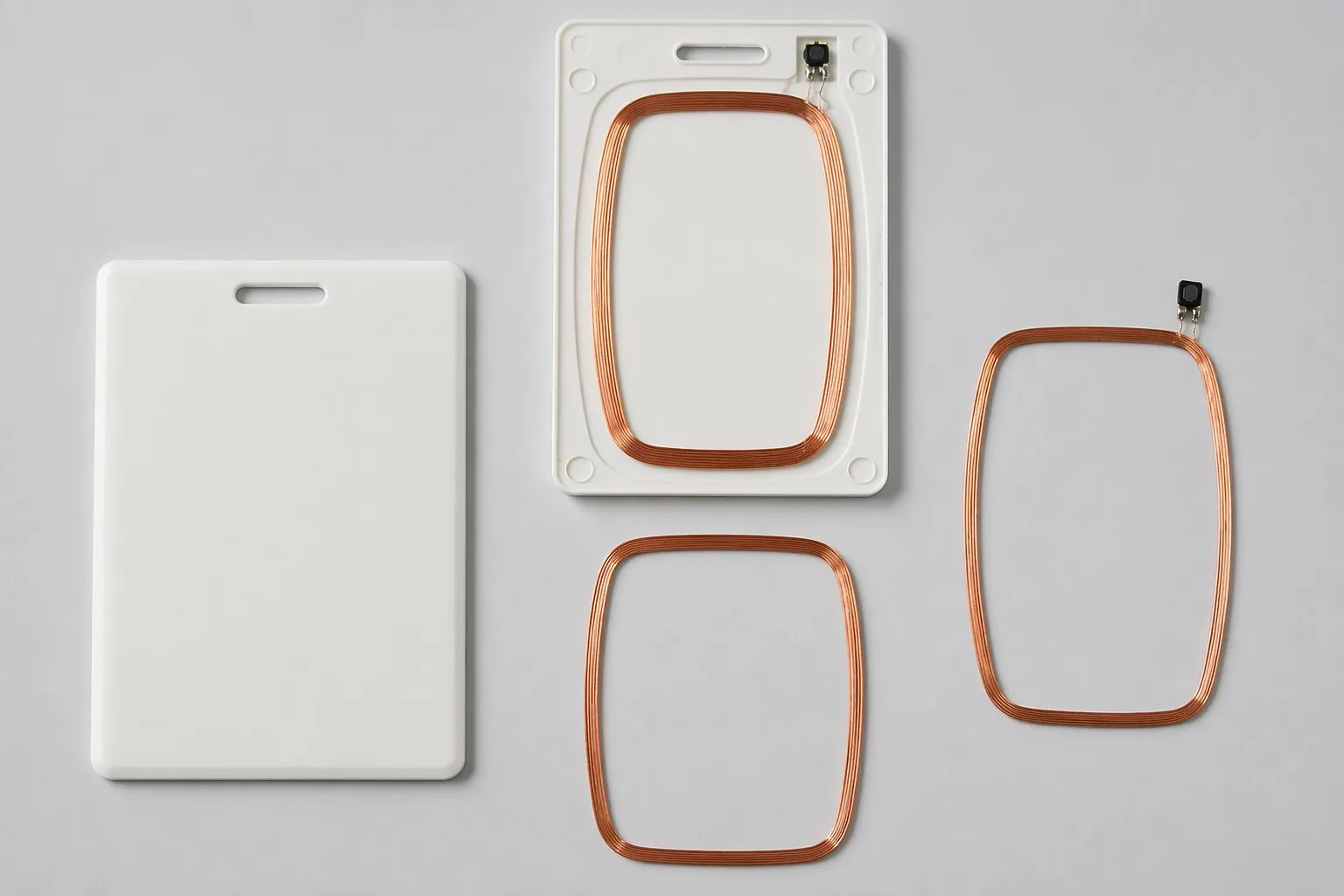
Most so-called “thick RFID cards” you find on Alibaba are a MIFARE 1K inlay sandwiched between two PVC layers by a converter who did not tool the shell, did not mould the plastic, and does not know the impedance of the antenna they laminated. The 13.56Mhz Mifare 1k Thick Card leaves our Shenzhen production campus differently. ABS pellets in, a large single-loop copper-wire coil wound in, a MIFARE 1K chip module soldered to the coil terminals, matched-pair ABS shells injection-moulded, the coil dropped into the shell’s internal recess, top-half shell ultrasonic-welded into a monolithic block. What ships to your loading dock is not a laminated sandwich — it is a moulded plastic block with an NFC nervous system sealed inside it. Manufactured on a Shenzhen production floor operating since 2008, on one of five dedicated card production lines running two shifts.
The Difference Between Manufactured and Sourced
The word “clamshell” comes from the two mirrored ABS half-shells that snap together like a clam. In cheap sourced product, those halves are glued — the glue line lets water in after three or four months in a coastal or humid environment, and the copper coil corrodes silently until one morning the card just stops reading. In the 13.56Mhz Mifare 1k Thick Card as we make it, the two halves are ultrasonic-welded at 20 kHz across the entire perimeter, forming a molecular bond in the ABS itself. No adhesive. No moisture ingress path. The 14 × 3 mm horizontal lanyard slot at the top-centre of the card is cored during shell moulding, not drilled after welding, so the internal copper coil is routed around the slot cavity rather than cut by it. These are the things a spec sheet does not tell you and a laminator cannot do.
Raw Material Selection
ABS pellets are sourced from LG Chem and Chi Mei Corporation grades verified for consistent Shore-D hardness (78–82) and UV-stability class HB — the same grades that go into automotive interior trim, because we found early on that no-name ABS yellows visibly within 6 months of outdoor lanyard use. The HF antenna is a single-loop enamelled copper wire (0.10–0.15 mm diameter) wound as a large rounded rectangle roughly 76 × 46 mm that occupies most of the card’s internal cavity — one continuous loop, not a multi-turn spiral, matched to the MIFARE 1K chip’s ~17 pF input capacitance so the antenna resonates cleanly at 13.56 MHz inside the 1.9 mm-thick ABS enclosure. The MIFARE Classic 1K die is sourced from NXP or, on cost-optimised runs above 5,000 pcs, as the FM11RF08 functional equivalent from Shanghai Fudan. State-of-record: NXP’s Crypto-1 cipher was academically broken by Karsten Nohl in 2008 and Proxmark 3 supports “nested” and “hardnested” attacks, so do not specify Classic 1K for new high-security payment or master-key deployments — use DESFire EV2 (AES-128) for those and treat the 13.56Mhz Mifare 1k Thick Card as your workhorse access-and-attendance token instead.
Step-by-Step Production Walk-Through
Every 13.56Mhz Mifare 1k Thick Card goes through the following six-stage flow on our clamshell line:
- Copper coil winding. Enamelled copper wire (0.10–0.15 mm) is wound on a rounded-rectangle jig to produce a single large loop approximately 76 × 46 mm, matched to the MIFARE 1K chip’s ~17 pF input capacitance. Inductance verified on an HP 4291A network analyser at cavity level, 100% coverage. Any coil outside ±5% tolerance is scrapped.
- Chip module soldering. The MIFARE 1K COB (chip-on-board) module is soldered directly to the two coil terminals at the top edge of the loop, adjacent to where the lanyard slot will be. Solder-joint strength verified on a Dage 4000 pull-tester at 3 g minimum, 4-piece random sample per 1,000-piece lot.
- Half-shell injection moulding. Top and bottom ABS half-shells are moulded in a paired 8-cavity tool with the 14 × 3 mm top-centre lanyard slot cored (not drilled), rounded corners, and a shallow internal recess that seats the copper coil during assembly. Cycle time 22 seconds per pair.
- Coil seating. The chip-soldered copper coil is dropped into the recess of the bottom half-shell — no adhesive, no foam spacer. The coil is mechanically located by the moulded recess itself and held flat by the top-shell surface at weld.
- Ultrasonic welding. Top half-shell placed, ultrasonic horn at 20 kHz applies 300 W across the perimeter energy directors for 0.3 seconds. The ABS melts and re-solidifies as one continuous piece. No adhesive is used. Weld quality inspected by pull-apart test on 3-piece random sample per 500-piece lot at 25 N minimum.
- Encoding, marking, and 100% functional test. Every finished 13.56Mhz Mifare 1k Thick Card is read on a Feig ID CPR40 desktop reader at cavity level, its UID logged into the batch CSV, laser-engraved with the customer-specified serial or graphic if ordered, and cross-checked against the CSV before packing.

Craftsmanship Meets Consistency
Two things about the process above are worth calling out. First, the copper coil is not laminated — it is mechanically located inside the moulded ABS recess and mechanically enclosed by the welded top shell. That means a 2 m drop onto concrete flexes the ABS shell but does not stress the coil. In our internal drop-test protocol (100 drops from 1.5 m onto sealed concrete floor), the 13.56Mhz Mifare 1k Thick Card survives at 99%+ read reliability versus roughly 62% for equivalent laminated CR80 cards. Second, the ultrasonic welding is done by trained operators, not fully-automated robots — the machine is automated but the operator makes final visual quality calls on the weld line before every card leaves the station. On our clamshell line we run 5 welding stations with 5 operators per shift; peak weekly output is 180,000 pcs.
Why “Thick Card” Is Not Cosmetic — It’s a Deployment Decision
A thin CR80 card (0.76 mm) is designed to sit in a wallet next to a driver’s licence. A thick clamshell card (1.9 mm) is designed to hang from a retractable badge reel or a lanyard threaded through the top-centre slot. Those are two different jobs. If your deployment involves outdoor use, gloved handling, drop hazards, or any scenario where the card is not tucked into a wallet, the thick clamshell form is the objectively correct answer. Common deployments where we ship the 13.56Mhz Mifare 1k Thick Card in six-figure annual volumes: gated-community door access, factory shift-attendance tap-in, warehouse operator ID, delivery-driver dock access, hotel back-of-house staff access (not guest room keys — those stay thin CR80 for wallet compatibility), and municipal-facility lanyard cards.
The People Behind the Line
The clamshell line runs across the same 5,000 m² dust-free workshop that produces our thin PVC cards, wristbands, and inlays — but on dedicated equipment, because ABS injection moulding and PVC lamination cannot share a line. Total workforce across the campus is 200+ skilled workers. The clamshell line specifically operates with 12 line workers per shift, 2 shifts a day, plus 1 dedicated line QC lead, 1 line engineer, and 1 tooling maintenance technician. Every 12 months we scrap and re-tool the injection moulds — ABS moulds do not last forever, and running past the tooling life causes flash and dimensional drift that our QC will reject at incoming stage.

Technical Specifications
| Parameter | Standard offer | Customisable range |
|---|---|---|
| Operating frequency | 13.56 MHz | — |
| Standard / protocol | ISO/IEC 14443 Type A | — |
| Chip | MIFARE Classic 1K (NXP S50) | FM11RF08 (Fudan, cost-optimised); MIFARE Ultralight EV1 / NTAG213 / DESFire EV2 on request |
| User memory | 1 KB (16 sectors × 4 blocks) | Up to 8 KB on DESFire EV2 |
| UID length | 4-byte (default) or 7-byte on request | — |
| Card body | ABS clamshell, ultrasonic-welded | PVC laminated on request (thinner form factor) |
| Dimensions | 86 × 54 × 1.9 mm (thick clamshell format) | Custom die-cut shape via new mould (MOQ 3,000) |
| Weight | ~10 g per card | — |
| Colour | White (default) | Any Pantone matched to ΔE ≤ 2.0 |
| Lanyard slot | Standard 14 × 3 mm horizontal slot at top-centre | Two-slot or no-slot variants on request |
| Read distance | 3–8 cm on standard 13.56 MHz reader | Up to 10 cm on high-power desktop reader |
| Antenna | Single-loop enamelled copper wire, ~76 × 46 mm rounded rectangle | Multi-turn winding on request for extended read range |
| Marking | Silk-print, offset print, laser-engraved serial + CSV mapping | Emboss / deboss / UV spot-varnish / metallic ink |
| Encoding | UID default; sector encoding, key A/B change, access-condition setting | Full sector-write per client CSV, raw-hex write on request |
| Operating temperature | –25 °C to +85 °C | –40 °C to +105 °C on HT ABS grade |
| IP rating | Water-splash resistant (IPX4 equivalent) | IP67 on fully sealed variant |
| Drop-survival | 1.5 m onto concrete, 99%+ read reliability at 100 drops | — |
| MOQ | 100 pcs standard; 500 pcs custom colour / chip; 3,000 pcs new mould | — |
| Lead time | 7–14 business days standard; +7–10 custom Pantone; +25–35 new mould; +30–40 CNY buffer | — |
| Certifications | ISO 9001:2015 (factory); RoHS 2011/65/EU; REACH SVHC | — |
| HS Code | 8523.52 | — |
What You Can Customise
- Shell colour: 12 stock Pantone colours in ABS masterbatch, or custom Pantone matched to ΔE ≤ 2.0 verified on a Konica Minolta spectrophotometer. Custom Pantone adds 7–10 days for masterbatch compounding.
- Chip: MIFARE Classic 1K (default), FM11RF08 (cost-optimised at 5,000+ pcs), Ultralight EV1, NTAG213, or DESFire EV2. The 13.56Mhz Mifare 1k Thick Card antenna is impedance-tuned to the specific chip you select at order time.
- Marking: silk-print (Pantone), offset print (four-colour graphics), laser-engraved individual serial with CSV mapping, embossed or debossed logo, UV spot-varnish accent, metallic ink hot-stamp.
- Encoding: UID-only (fastest turnaround), full sector encoding per client CSV, key A/B pre-change to your specified value, access-condition byte setting, or raw-hex write.
- Structural: standard 14 × 3 mm horizontal lanyard slot at top-centre, or dual-slot variant for retractable-reel + lanyard combination, or no-slot variant for pocket-only use.
Where the 13.56Mhz Mifare 1k Thick Card Fits — And Where It Doesn’t
The 13.56Mhz Mifare 1k Thick Card is the correct choice when your access-control, time-attendance, or membership programme requires: durability under drop / crush / weather stress; lanyard or badge-reel attachment via the top-centre slot; visual differentiation from thin credit-format cards; and 13.56 MHz MIFARE 1K compatibility with your existing reader estate (HID iCLASS SE, ZKTeco KR500 / KR503, Suprema BioEntry Plus, Iron Logic Matrix-II NFC, ACR122U, PN532, Feig CPR30 / CPR40, Kaba K7, Nedap AEOS). It is the wrong choice when your programme requires: wallet-compatibility (thin cards win — see our Mifare 1K RFID White Card product page for the thin PVC alternative on the same chip); cryptographic authentication for payment or master keys (specify DESFire EV2 instead); or long-range asset tracking above 30 cm (UHF 860–960 MHz is your frequency band, not 13.56 MHz). For LF 125 kHz clamshell deployments where the reader estate is legacy EM4200 / TK4100, see our Proximity 125khz Clamshell Card instead.
FAQ
Q1: What is the difference between a “thick card” and a “clamshell card”?
They are two names for the same product family. “Thick card” describes the geometry (~1.9 mm versus the 0.76 mm CR80 standard). “Clamshell” describes the construction (two mirrored ABS shells ultrasonic-welded together). The 13.56Mhz Mifare 1k Thick Card is a clamshell card; every clamshell card at this thickness is a thick card. Some suppliers use the words interchangeably; we use both on this page because both are the terms your buyer searches for.
Q2: Can the 13.56Mhz Mifare 1k Thick Card be printed with our logo or four-colour graphics?
Yes. Silk-print with up to 4 Pantone colours is the fastest and cheapest option (5 business days lead time added). Full four-colour offset print with UV spot-varnish is available for high-volume orders (10,000+ pcs) and adds 10 business days. Laser-engraved individual serial numbers with CSV mapping are supported on any order size.
Q3: How does the ultrasonic weld hold up compared to glue-bonded clamshell cards?
Ultrasonic welding forms a molecular bond in the ABS itself, so pull-apart strength is essentially the tensile strength of the ABS material (roughly 25 N minimum in our line QC test, but typical failure requires more force than the surrounding shell can absorb). Glue-bonded shells fail at the glue line, typically within 3–12 months in outdoor or humid environments, and are the reason no-name clamshell cards develop the “loose click” that eventually leads to coil failure.
Q4: What is the smallest order size and what does the sample process look like?
MOQ on the standard 13.56Mhz Mifare 1k Thick Card (white ABS, MIFARE Classic 1K, 14 × 3 mm top-centre lanyard slot, no printing) is 100 pcs. Custom colour or custom chip raises MOQ to 500 pcs; a new custom mould raises MOQ to 3,000 pcs. Before any order, we ship a free 10-piece verification sample kit via DHL/FedEx in 5–7 business days to any verified company address — enough for your access-control installer to test on your specific reader model.
Q5: Should we specify Classic 1K, Ultralight EV1, or DESFire EV2 for our deployment?
MIFARE Classic 1K if the deployment is legacy-reader access-control or time-attendance where the reader estate already speaks Classic — its 1 KB memory and 16-sector layout is standardised across every enterprise access system built before 2020, and the 2008 Crypto-1 vulnerability does not compromise closed-loop non-payment applications. MIFARE Ultralight EV1 if you want the cheapest possible per-card cost and only need UID-based identification. DESFire EV2 (AES-128) if the deployment involves payment, master-key duplication risk, or any scenario where cryptographic authentication is a compliance requirement.
Q6: What payment terms and shipping incoterms do you offer?
T/T 30% deposit + 70% before shipment is default for volume orders. Alibaba Trade Assurance is available for orders placed through our Alibaba store (xinxingsmart / Jingzhou Syntek Smart). PayPal accepted up to $5,000 order value. Western Union and MoneyGram accepted for sample-only payments. Shipping incoterms: EXW, FOB Shenzhen or Hong Kong, CIF, or DDP — quoted per destination country at RFQ. HS Code 8523.52 for smooth customs clearance in every major market.
Get Started
Tell us five things and we will quote inside one business day: (1) MIFARE 1K or an alternative chip, (2) target volume, (3) shell colour + printing / laser-marking requirement, (4) UID-only or full sector encoding, (5) standard top-centre 14 × 3 mm slot or a custom slot / no-slot geometry. Free 10-piece verification samples ship in 5–7 business days.
- Email: [email protected]
- WhatsApp: +852 5989 6589
- WeChat: 147891664