

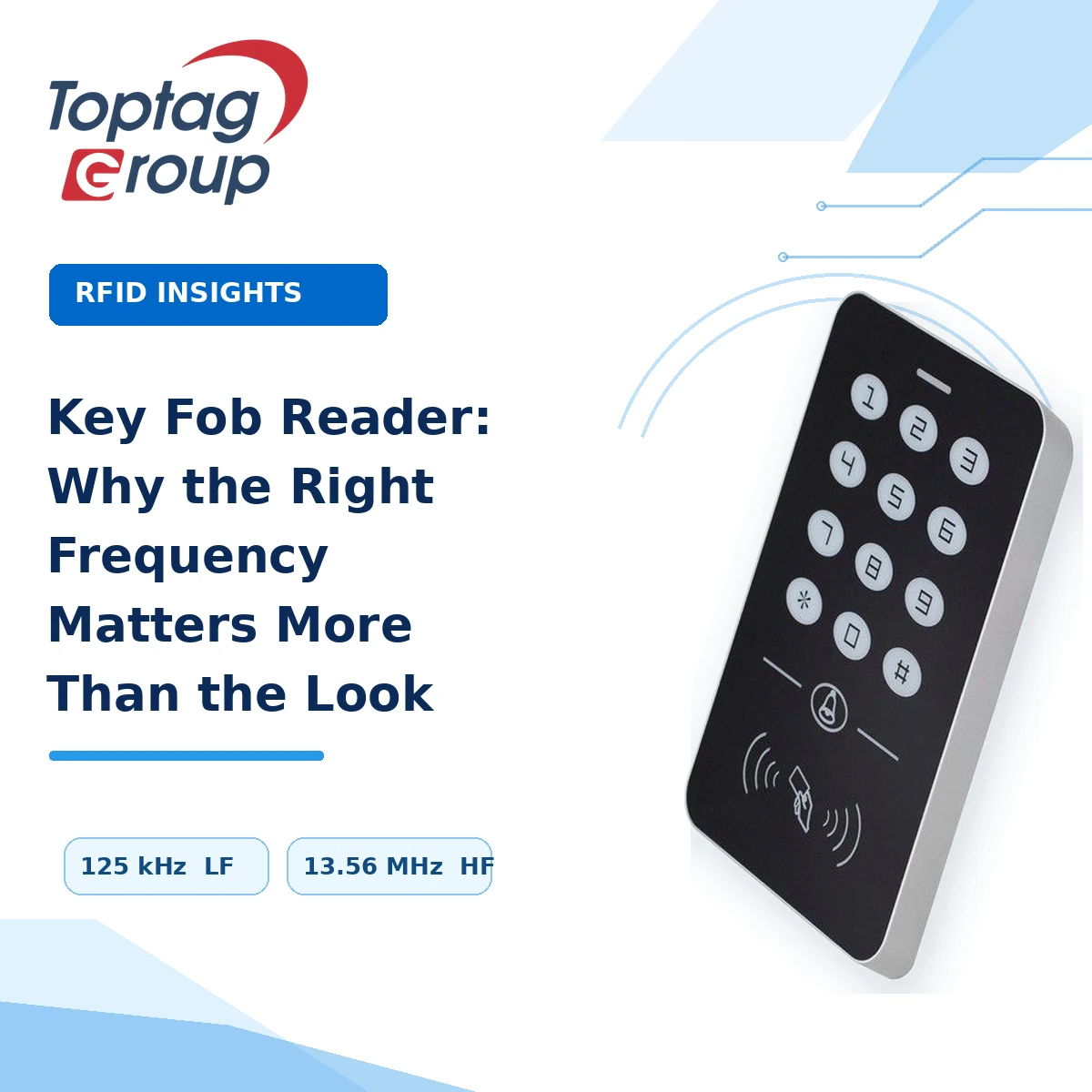
A property management company in Southeast Asia ordered 200 wall readers for a new office block. The units arrived, the electrician mounted them along the corridors, and the team handed out the RFID key fobs the same day. Half the fobs beeped green and opened the door. The other half flashed red, no matter how hard residents pressed them to the glass. The procurement team had matched the price and the housing color, but not the frequency inside the key fob reader. The order had to be split again, and the retrofit ran two weeks past handover.
The Wrong Band Behind a New Reader Failure
Reader failures on a new installation almost never come from a broken reader. They come from a frequency mismatch. The building mixed two credential generations: older 125 kHz proximity fobs from the previous contract, and newer 13.56 MHz smart fobs ordered with the batch. A wrong-band key fob reader cannot talk to the other band, even if both fobs and readers look identical on the wall.
A second problem appears after occupancy: a lost fob replaced with a cheap clone still works on a legacy proximity system. Both issues sit on the reader side, so finish the band and protocol check before comparing housings.
125 kHz vs 13.56 MHz: The Reader Side of the Match
A 125 kHz key fob reader works with legacy proximity credentials: EM4100, Unique or TK4100 style fobs, common in older access control, parking gates and simple door entry. The range is short, a few centimeters, and the credential carries a fixed card number that is easy to copy. Most low-cost doors still run this band because fobs and readers are inexpensive.
A 13.56 MHz key fob reader works with smart credentials: MIFARE Classic, DESFire, NTAG and NFC-based fobs. The band supports encrypted sectors, read-write data and facility-specific authentication. Readers here cost more, and they need a controller that understands the same smart protocol, not just the same radio band.
For a retrofit, check the existing fobs before choosing the reader. Proximity fobs will not open a 13.56 MHz reader, and a 125 kHz reader cannot add encryption later. Compare the LF credential selection and the Οδηγός για RFID κλειδιά-φοβ for form factors buyers consider before a bulk order.
Same Frequency, Different Protocol: Why the Fob Still Fails
Matching the band is not the whole check. Two products can sit at 13.56 MHz but speak different protocols. A MIFARE Classic reader does not read a DESFire fob the same way, and an NTAG NFC fob responds to a phone differently from a door reader. The radio frequency overlaps; the authentication and data structure do not.
On the 125 kHz side the risk is lower, but the clone format still matters. EM4100 readers read fixed-number proximity fobs; some boards expect a specific Wiegand bit length, and a fob formatted for another facility may present a number the controller rejects. Ask the key fob reader supplier which chip types and card formats the unit supports, not just “125 kHz compatible.”
List the fob chip, protocol, output interface and existing controller on the RFQ. A key fob reader that matches only one of those four can still fail at the door.
Read Range, Interface and Installation Position
The key fob reader read range decides whether the user must stop and press the fob to the glass. Proximity readers typically read within 1 to 5 centimeters; smart card readers sit in a similar short range. Metal frames, reinforced glass, wiring behind the reader and nearby cables all shorten that range. A listed 10 cm range can drop to 2 cm once the reader is mounted on a steel frame.
Every key fob reader must match its controller interface. Wiegand 26 and Wiegand 34 are the most common door reader outputs; RS485, OSDP and proprietary buses appear on newer systems. If the controller only takes Wiegand, a reader on a different bus needs an adapter or a replacement controller. Check bit length too, because a 34-bit credential on a 26-bit controller drops facility bits.
Wet and exposed doors need the right housing. Indoor lobby readers take a sealed plastic case; a car park, external gate or wash-down entrance needs an IP-rated reader with a gasketed face. Check the access control reader range on our category page for sealed outdoor housings. Do not put an indoor reader on a rain-facing entry just because it is cheaper.
Cloning Risk the Reader Can and Cannot Stop
A key fob reader itself changes only part of the clone risk. Legacy 125 kHz fixed-number fobs copy easily, and the reader accepts a duplicate number the same as the original. Moving to a 13.56 MHz encrypted fob raises the bar, but the reader still has to support the encrypted protocol and the controller verify the sector. A smart fob used on a plain proximity reader loses that protection.
Readers can add tamper detection, keypad entry and dual-factor modes, but they cannot rebuild a weak card system alone. For a site that replaces fobs often, audit the cloning path first. Our RFID copier article explains which chip families can be duplicated in the field, so the team knows what the reader side must defend.
For a reception desk, pair the reader with a fob enrollment station. For a single external gate, prioritize weather sealing and a clean bus match to the existing panel.
Quick Answers and the Order Checklist
Can a key fob reader read both 125 kHz and 13.56 MHz fobs? Some multi-frequency readers exist, but they are a separate product. Do not assume a standard reader switches bands in the field, and confirm the protocol list even on a dual-band unit.
What interface do most office doors use? Wiegand 26 is the legacy default; Wiegand 34 handles longer facility numbers. Newer secure systems use OSDP over RS485.
How close should the fob be to the key fob reader? Plan for 1 to 5 centimeters in normal installation. Test the mounted position on the actual door frame before sign-off.
Does the reader stop cloned fobs by itself? Only partially. The credential chip and controller verification do most anti-clone work; the reader passes the number through.
Write these lines on the RFQ:
- Credential band, 125 kHz or 13.56 MHz, for every door group
- Chip and protocol, EM4100, MIFARE Classic, DESFire, NTAG or other
- Output interface, Wiegand 26/34, RS485 or OSDP
- Read range and mounting surface, including metal frames
- IP rating for external or wet entries
For a multi-door fit-out, send the existing controller model and fob sample through our contact us page. Matching the key fob reader to the actual credential before production avoids a second reader order after the doors are live.