

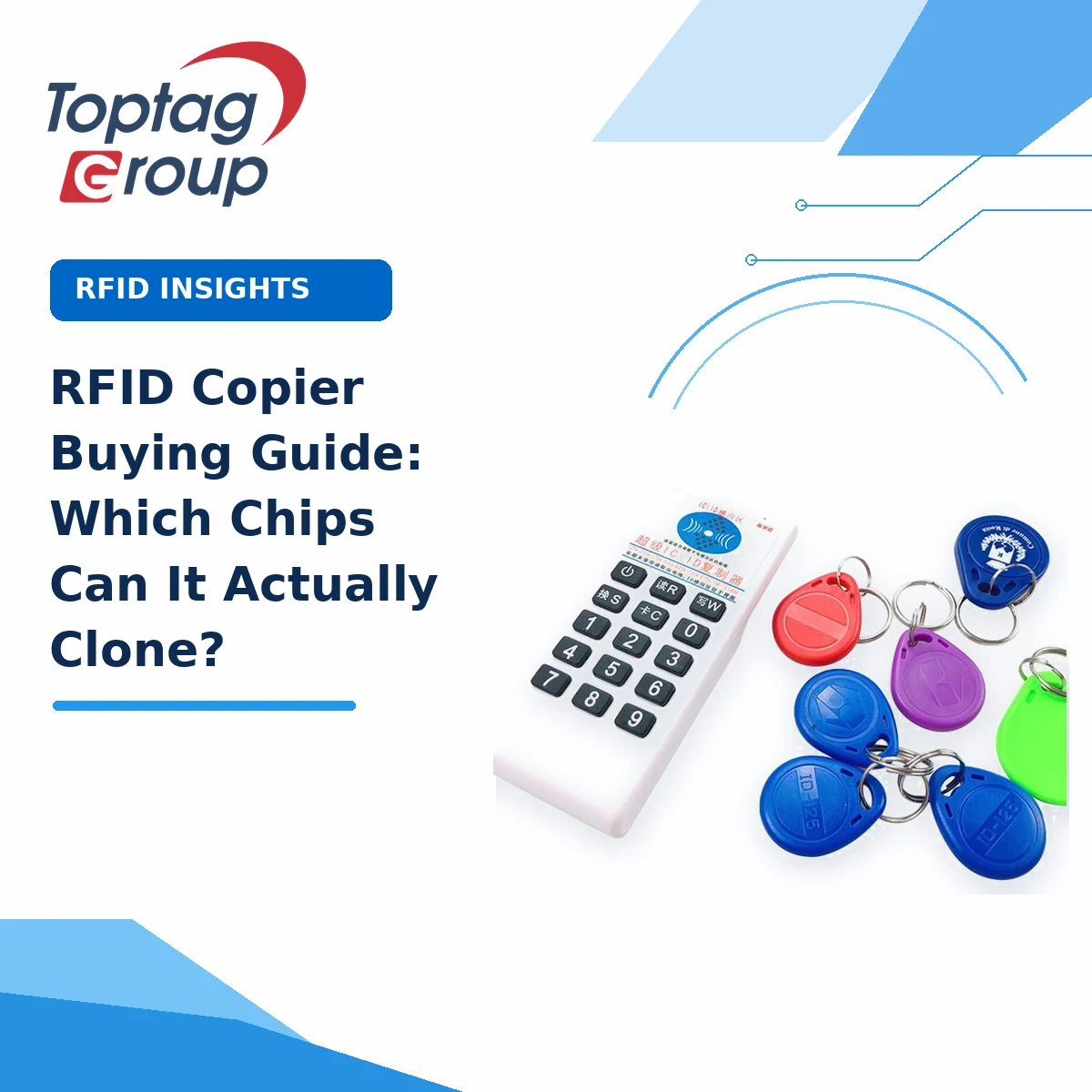
A gym operator in Manchester replaced member cards at GBP 2.10 each. With 2,000 active members and a 15% annual loss rate, that was GBP 630 a year in plastic plus staff time. He bought a GBP 150 handheld rfid copier from a reseller and cloned 900 cards in one weekend. Then he hit the other 1,100. Those were Mifare Classic 1K cards with custom sector keys, and the cloner could read the UID but not the encrypted blocks. Half his member base still needed factory-ordered cards.
Sellers advertise “universal” and buyers assume every card behaves the same. It does not. Chip family, key management and whether the UID is writable decide what an rfid copier can do, long before brand or price matter.
What an RFID Copier Actually Reads and Writes
Three different jobs get sold under one name:
- Read the UID. Every card answers with a serial number. Most cheap devices stop here.
- Read and write data blocks. This needs the right sector keys for that card family.
- Write a new UID. Only “magic” cards with a rewritable UID block accept this.
A GBP 40 device usually does the first job and writes the number to a T5577 blank. A GBP 200–400 device does all three for unencrypted 125 kHz and basic 13.56 MHz cards. Above that you are paying for key recovery, a bigger chip database and a screen that shows you what it found.
Ask any rfid copier seller which jobs their device performs. If the answer is “all cards”, ask for the chip list in writing.
The Chip List: What Copies and What Does Not
Copy behaviour by family:
- EM4100 and TK4100, 125 kHz. Read-only chips with a fixed UID. Copy to a T5577 or an EM4100 blank. Works on almost every cloner.
- T5577, 125 kHz. Read and write. Doubles as a target blank for EM4100 clones. The T5577 RFID card page on our site explains the block layout.
- HID Prox, 125 kHz. Proprietary format. Some cloners support it, many claim to and fail. Test one card before you buy 5,000 blanks.
- Mifare Classic 1K, 13.56 MHz. Cloneable when sectors use default keys. With custom keys, only devices with key recovery can finish the job.
- Mifare DESFire and iCLASS SE. Encrypted with diversified keys. No handheld rfid copier clones these. Anyone who says otherwise is selling a reader with a marketing sticker.
- NTAG213 and NTAG215. Read and write freely. Cloning to a UID-writable NTAG sticker works, but the tag then carries your data, not the original’s.
- UHF EPC Gen2. You can read the EPC. Writing a new EPC needs a tag with the same chip and a device that supports UHF, which most handheld copiers do not.
A dealer in Dubai stocked 6,000 T5577 blanks for a hospital tender, then found the hospital used Mifare DESFire. The blanks sat in his warehouse for 14 more months.
Form Factor: Handheld, Desktop or Bluetooth
Three shapes:
- Handheld with battery and screen. Best for a technician walking a building. Reads and writes without a laptop. Expect 8–12 hours per charge.
- Desktop USB unit. Cheaper per unit, needs a PC, usually ships with software that logs every card it touches. Good for a back office that issues 50 cards a day.
- Bluetooth or app-driven unit. Convenient, but firmware and app quality vary wildly. Check that the app works offline in basements and plant rooms.
A hotel in Kuala Lumpur issues 400 staff cards a month. A USB desktop rfid copier with a logging tool cut issuance from two days to four hours, and the log settled a dispute about who wrote a master key card.
Buy the shape that matches where the work happens.
Range, Error Rate and Batch Speed
Real numbers on a bench:
- 125 kHz read: 3–8 cm on a handheld, 10 cm on a good desktop antenna.
- 13.56 MHz read: 2–5 cm, dropping to 1 cm through a phone case or a thick card holder.
- Write and verify: 1–2 seconds per card on LF, 3–5 seconds on HF with encryption checks.
Batch speed matters more than range for most buyers. Any rfid copier that writes 300 cards an hour sounds fine until you need 2,000. Ask the seller for a timed demo of 100 consecutive writes with a verify pass, not a single-card video.
Error rate is the number nobody publishes. After cloning, read each new card five times at the real reader distance. A 2% failure rate on 2,000 cards means 40 members stuck at the gate on a Monday morning.
Legal and Operational Limits
An rfid copier is a tool, and the law treats it like one. Copying a card you do not own or administer is unauthorized access in most jurisdictions, even if the gate opens. Keep three rules in the workflow:
- Only copy cards from the site you operate, with written authorization from the client.
- Keep a log of every card cloned: date, operator, source UID, target UID.
- Stop when a card resists. Encrypted cards are a signal that the system was designed to prevent exactly this.
For a distributor, the honest pitch is spare capacity. A building manager with 300 tenants needs 20 replacements a month, and a 400-pound rfid copier pays for itself in one quarter against factory lead times. If you need 5,000 new cards rather than copies, ordering blanks beats cloning on both unit price and compliance. The RFID cards for access control guide on our site covers that comparison.
ΣΥΧΝΈΣ ΕΡΩΤΉΣΕΙΣ
Can an rfid copier clone any card? No. It handles unencrypted 125 kHz and basic 13.56 MHz cards. DESFire, iCLASS SE and CPU cards are out of reach for handheld devices.
Do I need a copier or just spare cards? Under 100 cards a year, order spares. Above 300, an rfid copier with a logging tool usually wins on turnaround time.
Will a cheap cloner damage the original card? Reading is passive and safe. Writing to a wrong block on a rewritable card can brick that card, so always clone to a blank, never to the source.
Can I copy a hotel or office master card? Only with written authorization from the operator. Without it you are building a master key, which is a criminal matter in most countries.
Before you order, send us the card type, the chip family and a photo of the reader. We will tell you whether an rfid copier is the right tool or whether a batch of T5577 or Mifare cards solves it cheaper. For staff who already clone fobs daily, the key fob copy guide covers the duplicator workflow step by step.