


Abstract:
MIFARE Classic 1K and 4K are the most widely deployed contactless smart card ICs from NXP Semiconductors. They operate at 13.56 MHz in compliance with ISO/IEC 14443-A and differ primarily in their EEPROM storage capacity. 1K offers 1,024 bytes organised across 16 sectors and 4K provides 4,096 bytes organised across 40 sectors (NXP Semiconductors, MIFARE Classic EV1 Product Data Sheet, 2023).
According to the ISO/IEC 14443-A standard from the International Organization for Standardization and NXP’s official documentation, both variants use the same CRYPTO1 authentication algorithm and physical form factor. This makes them largely interchangeable at the reader hardware level, although they diverge significantly in terms of data capacity and application scalability. For deployments requiring multi-application architectures — such as combining physical access control, loyalty tracking, and transit ticketing on a single credential — the 4K variant or its successor, the MIFARE Classic EV1 4K, is the industry-recommended choice (NXP Product Portfolio Guide, Rev. 4.1, 2022).
Understanding the MIFARE Classic Family: A Technical Foundation
MIFARE Classic is one of the world’s most ubiquitous contactless smartcard standards, with over 10 billion chips having been deployed in transit systems, access control installations, loyalty programmes and event ticketing since NXP Semiconductors (then a division of Philips) introduced the technology in 1994. The name ‘MIFARE’ derives from ‘MIkron FARE-collection System’, reflecting its original application in the transportation sector. Today, the MIFARE Classic 1K and 4K variants form the backbone of billions of installed readers and system deployments, ranging from hotel key cards to urban metro systems in Europe and Asia.
Both variants operate at a carrier frequency of 13.56 MHz, comply with ISO/IEC 14443 Type A for the air interface layer, and communicate at a data rate of 106 kbit/s. They both use the same proprietary CRYPTO1 stream cipher for authentication and data encryption between the card and the reader. Each card contains a globally unique 4- or 7-byte UID (Unique Identifier), which is programmed during manufacturing and write-protected to ensure counterfeit resistance at the basic identity layer.
The key architectural difference between the two variants is the amount of EEPROM available for user data and the number of sectors that partition that memory. While both use the same sector-and-block model, whereby each sector is protected by two independent keys (Key A and Key B) and an access condition byte, the 4K card simply provides more sectors, storage, and flexibility for multi-application design. It is important to understand this distinction when specifying credentials for complex deployments, particularly when a MIFARE Classic 1K key fob or card will need to carry multiple independent data partitions in the field.
Memory Architecture: Sectors, Blocks, and the Real Difference
The single most important technical distinction between the 1K and 4K variants lies in their memory layout. The table below summarizes the core specifications:
MIFARE Classic 1K vs. 4K — Core Specifications
| Total EEPROM | 1,024 bytes (1 KB) | 4,096 bytes (4 KB) |
| Total Sectors | 16 | 40 (32 small + 8 large) |
| Blocks per Small Sector | 4 blocks × 16 bytes | 4 blocks × 16 bytes |
| Blocks per Large Sector | N/A | 16 blocks × 16 bytes |
| User Data per Small Sector | 48 bytes (3 data blocks) | 48 bytes (3 data blocks) |
| User Data per Large Sector | N/A | 240 bytes (15 data blocks) |
| Total User Data Available | ~752 bytes | ~3,440 bytes |
| Authentication Algorithm | CRYPTO1 | CRYPTO1 |
| Operating Frequency | 13.56 MHz | 13.56 MHz |
| ISO Standard | ISO/IEC 14443-A | ISO/IEC 14443-A |
| Typical Form Factors | Card (CR-80), key fob, sticker | Card (CR-80), key fob, sticker |
| Rakstīt Izturība | 100,000 cycles | 100,000 cycles |
| Datu saglabāšana | 10 gadi | 10 gadi |
In the 1K variant, memory is divided into 16 sectors, each of which contains exactly four blocks of 16 bytes. The final block in each sector (Block 3) is reserved for the Sector Trailer, which stores Key A (6 bytes), the access condition bits (4 bytes), and Key B (6 bytes). This leaves three usable data blocks per sector, equating to 48 bytes of user data per sector and approximately 752 bytes in total across all 16 sectors.
In the 4K variant, sectors 0–31 have the same structure as the 1K card, with four blocks each, while sectors 32–39 are extended sectors, each containing 16 blocks. The last block (Block 15) of each large sector is the Sector Trailer, leaving 15 usable data blocks — or 240 bytes — per large sector. This asymmetric architecture is intentional: the smaller sectors handle simple applications with modest data requirements, such as a UID-linked access pass, while the larger sectors are reserved for data-intensive applications, such as value storage, transaction logs or multi-hop transit records.
For implementers, the practical implication is straightforward: if your application requires only one or two functions, such as a single-site door access record, then the MIFARE Classic 1K or its key fob equivalent provides more than sufficient capacity at a lower unit cost. However, if you need to segment the credential across multiple independent applications or carry richer data sets, the 4K variant provides the capacity to scale up.
Security Architecture: CRYPTO1, Key Management, and Known Vulnerabilities
The 1K and 4K variants both use the same 48-bit CRYPTO1 stream cipher, which NXP designed as a proprietary authentication mechanism. When it was introduced in the mid-1990s, CRYPTO1 was considered adequate for transit fare collection and basic access control. However, in 2008, researchers at Radboud University Nijmegen (Nohl et al., ‘Reverse-Engineering a Cryptographic RFID Tag’, USENIX Security 2008) published a complete cryptanalytic breakdown of CRYPTO1. This demonstrated that the secret key could be recovered from just a few hundred authentication attempts in less than a second using standard computing hardware. Subsequent research by García et al. (‘Wirelessly Pickpocketing a Mifare Classic Card’, IEEE S&P 2009) confirmed practical exploitation scenarios.
The 1K and 4K formats share this security history — neither variant is inherently more resistant to CRYPTO1 attacks than the other. Since then, NXP has released MIFARE Classic EV1, which has additional hardening measures against reader-only attacks and improved random number generation, as well as more secure successors, including MIFARE Plus, which is AES-128 based and backward-compatible, and MIFARE DESFire EV3, which has a DES/3DES/AES command set and open security architecture (ISO 7816-4).
For security-sensitive deployments, this distinction matters significantly:
① Low-security applications (gym lockers, event entry, short-term hotel keys): MIFARE Classic 1K or 4K EV1 remain cost-effective and practically sufficient where the cost of a credential attack exceeds the attacker’s incentive.
② Medium-security applications (corporate access control, campus credentials): MIFARE Plus offers backward compatibility with existing Classic-era readers during a migration phase, with the option to switch sectors to AES-128 once readers are upgraded.
③ High-security applications (government ID, payment adjacency, healthcare): MIFARE DESFire EV3 or similar open-standard AES cards are required; Classic variants are not recommended.
It should be noted that the security gap between 1K and 4K is purely one of data capacity, not cryptographic strength. Choosing the 4K over the 1K does not improve security posture; only migrating to a stronger authentication cipher achieves that.

Application Design: When to Choose 1K vs. 4K
The choice between a MIFARE Classic 1K key fob or card and its 4K counterpart is fundamentally an application architecture question, not simply a cost decision. System integrators and procurement teams should evaluate the following factors before standardizing on either variant:
① Single-application vs. multi-application deployments. If a credential serves one function — say, opening a single-site access door — 1K is more than sufficient. A standard access control record occupies fewer than 48 bytes, leaving entire sectors unused. The 4K becomes strategically valuable when the same physical credential must serve an access controller, a time-attendance logger, a cashless canteen balance, and a parking permit simultaneously, each requiring sector isolation under independent key management.
② Data logging and transaction history. Transit systems in particular require on-card transaction logs. A MIFARE Classic 4K can store approximately 70–120 individual 32-byte transaction records depending on formatting, whereas the 1K would be exhausted after 18–22 records. For single-ride or simple monthly-pass transit models, 1K suffices; for multi-operator transit networks requiring full audit trails on the card, 4K is architecturally necessary.
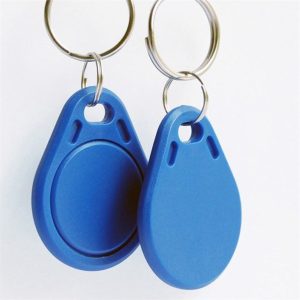
③ Key fob vs. card form factor. Both variants are available in key fob form factors (often referred to as MIFARE Classic 1K key fobs in supplier catalogs), including epoxy-potted clamshell fobs, wristband tags, and hard ABS housings. The chip inside a key fob operates identically to its card counterpart — the form factor difference is purely physical. Key fobs are particularly common in residential access control, vehicle gate management, and gym member systems due to their portability and durability.
④ Reader and system compatibility. Because 1K and 4K share the same ISO/IEC 14443-A air interface and CRYPTO1 authentication, virtually all readers capable of reading a 1K card will also read a 4K card. The reader communicates at the sector level; if an application only uses sectors 0–15, a 4K card behaves identically to a 1K card at those sectors. This makes 4K cards a popular “future-proof” specification choice in large installations where the system owner wants to preserve the option of expanding application scope without re-issuing all credentials.
Physical Form Factors and Encoding Standards
MIFARE Classic 1K and 4K — Common Form Factors and Industry Applications
| ISO CR-80 Card (85.6 × 54 mm) | 1K / 4K | Corporate access, hotel key, loyalty | ISO/IEC 7810 ID-1, ISO/IEC 14443-A | Most common form factor |
| Key Fob (epoxy/clamshell) | 1K (most common) | Residential gate, gym, parking | ISO/IEC 14443-A | Durable; IP67 variants available |
| Sticker Tag / Disc Tag | 1K / 4K | Asset tracking, equipment ID | ISO/IEC 14443-A | Thin profile; adhesive mount |
| Wristband (silicone/Tyvek) | 1K | Events, waterparks, hospitals | ISO/IEC 14443-A | Disposable or reusable options |
| Dual-Interface Card | 4K (common) | Corporate + transit combo | ISO/IEC 7816 + ISO/IEC 14443-A | Combines contact and contactless |
| Laundry Tag (ABS hard case) | 1K | Hotel linen tracking, uniform ID | ISO/IEC 14443-A | High-temperature resistant |
All of these form factors can be encoded using standard MIFARE reader/writer hardware that is compliant with ISO/IEC 14443-A and NXP’s MIFARE reader IC specifications. Encoding is performed sector by sector during the personalisation stage by the card bureau or system integrator using reader devices such as the NXP PN532, ACR122U (ACS), or equivalent OEM reader modules. The UID is factory-locked and cannot be modified on standard variants; only the user data sectors require programming during personalisation.
From a procurement standpoint, MIFARE Classic 1K key fobs represent the highest-volume segment in residential and light commercial markets, thanks to their low unit cost (typically $0.30–$1.20 per unit in bulk), durability, and broad compatibility with a range of readers. The 4K key fob is available, but is less common. Most integrators opt for a 4K ISO card for multi-application systems, while continuing to use 1K fobs for single-function credentials.

Migration Path and Industry Trends
While ubiquitous, the MIFARE Classic family is navigating a managed transition towards higher-security alternatives. While NXP has maintained the Classic product line due to its substantial installed base, the company has actively encouraged new deployments to use MIFARE Plus (which offers a backward-compatible AES upgrade path) and MIFARE DESFire EV3 for applications that require high security. Both the IEC 14443 working group and the GSMA have issued guidance recommending that CRYPTO1-based systems be migrated away from any environment handling financial transactions or sensitive personal data.
For existing 1K deployments, migration is generally straightforward if the reader infrastructure supports both Classic and AES simultaneously. A MIFARE Plus card can operate in compatibility mode (SL1) as a drop-in replacement for Classic cards and can then be switched to AES mode (SL3) on a per-sector basis as the reader firmware is updated. This allows credential security to be upgraded in phases without replacing all readers and cards simultaneously.
For organizations specifying new installations today, the practical guidance from industry consultants and NXP’s own application notes (AN10927 Rev. 1.3, 2021) is:
① If backward compatibility with a large installed Classic reader base is mandatory and threat modeling confirms low attack incentive, MIFARE Classic EV1 1K or 4K remains a defensible choice, with the EV1’s improved random number generator closing the most accessible attack vector.
② If starting fresh with a moderate security requirement, MIFARE Plus SE or MIFARE Plus X 2K/4K provides AES-128 without reader hardware change (in SL1 mode), future-proofing the installation.
③ If maximum security is required from day one, MIFARE DESFire EV3 with diversified keys, mutual authentication, and encrypted data channels is the appropriate specification.
FAQ: MIFARE Classic 1K vs. 4K — Frequently Asked Questions
Q1: What is the main difference between a MIFARE Classic 1K and 4K card?
The primary difference is memory capacity: the 1K card contains 1,024 bytes organized into 16 sectors, while the 4K card offers 4,096 bytes across 40 sectors (including 8 large sectors with 16 blocks each). Both use the same CRYPTO1 authentication algorithm and ISO/IEC 14443-A air interface, so they are reader-compatible at the hardware level.
Q2: Can a MIFARE Classic 4K be used in a reader designed for 1K cards?
Yes, in virtually all cases. Since both variants share the same ISO/IEC 14443-A protocol and CRYPTO1 authentication, a reader capable of handling a 1K card can also communicate with a 4K card using sectors 0–15 without any configuration change. The additional sectors (16–39) on the 4K card are simply inaccessible to an application that does not address them.
Q3: Is a MIFARE Classic 1K key fob secure enough for access control?
For low- to medium-risk access control (residential gates, gym entry, parking), the 1K key fob remains widely used and practically sufficient when properly keyed with non-default Key A/B values. However, CRYPTO1 has known academic vulnerabilities; for high-security applications — particularly those in regulated environments — MIFARE Plus or DESFire EV3 credentials are recommended.
Q4: What does a MIFARE Classic 1K key fob store, and how much data can it hold?
A MIFARE Classic 1K key fob stores a 4-byte or 7-byte UID (factory-locked) plus approximately 752 bytes of user-accessible EEPROM across 16 sectors. Typical access control applications use only one or two sectors, leaving the majority of the card’s capacity unused — making the 1K more than adequate for most single-function deployments.
Q5: How long do MIFARE Classic credentials last?
NXP specifies a write endurance of 100,000 write cycles per memory block and a data retention period of 10 years under standard operating conditions (per NXP MIFARE Classic EV1 Product Data Sheet, Rev. 3.3, 2023). Physical durability of the form factor (card vs. fob) depends on the housing material and environmental conditions, with epoxy key fobs typically rated to IP67 in commercial implementations.
Q6: What is the difference between MIFARE Classic and MIFARE Plus?
MIFARE Classic uses the proprietary CRYPTO1 48-bit cipher, which has documented vulnerabilities. MIFARE Plus is NXP’s backward-compatible successor, using AES-128 encryption at Security Level 3 while operating as a MIFARE Classic emulator at Security Level 1. This allows organizations to deploy Plus credentials in existing Classic reader infrastructure and upgrade the security mode incrementally as readers are updated, without replacing all credentials simultaneously.
Secinājums
The distinction between MIFARE Classic 1K and 4K cards, and their key fob equivalents, ultimately comes down to application architecture rather than security differentiation. Both types of card share the same authentication protocol, physical interface, and known cryptographic limitations. The 1K variant, including the widely deployed MIFARE Classic 1K key fob, remains the industry standard for single-function, cost-sensitive deployments where the credential needs to perform one task reliably and on a large scale. The 4K variant offers greater value in multi-application environments, such as transit systems, campus credentials and combined access and loyalty programmes, where sector isolation and increased data capacity justify the additional cost.
For organisations specifying new systems in 2024 and beyond, the most security-conscious approach is not to choose between 1K and 4K, but to evaluate whether the CRYPTO1 cipher underlying both variants is appropriate for the threat environment. Where it is not, MIFARE Plus and DESFire EV3 offer migration-friendly alternatives that preserve significant infrastructure investment while delivering modern cryptographic assurance.
References:
- NXP Semiconductors. MIFARE Classic EV1 1K/4K Product Data Sheet, Rev. 3.3. NXP, 2023.
- NXP Semiconductors. AN10927 — MIFARE and handling of UIDs, Rev. 1.3. NXP Application Note, 2021.
- NXP Semiconductors. MIFARE Product Portfolio Guide, Rev. 4.1. NXP, 2022.
- Nohl, K., Evans, D., Starbug, S., and Plötz, H. “Reverse-Engineering a Cryptographic RFID Tag.” USENIX Security Symposium 2008, San Jose, CA, pp. 185–193.
- Garcia, F., de Koning Gans, G., Muijrers, R., et al. “Wirelessly Pickpocketing a Mifare Classic Card.” IEEE Symposium on Security and Privacy (S&P) 2009, Oakland, CA, pp. 3–15.
- International Organization for Standardization. ISO/IEC 14443-3:2018 — Identification Cards: Contactless Integrated Circuit Cards, Part 3: Initialization and Anticollision. ISO, 2018.
- NXP Semiconductors. MIFARE Plus EV1/EV2 Product Family Data Sheet, Rev. 2.0. NXP, 2022.
- NXP Semiconductors. MIFARE DESFire EV3 Product Data Sheet, Rev. 1.1. NXP, 2023.
- GSMA. Smart Card Technical Specification: Contactless Card Standards Guidance. GSMA TS.43, 2021.