


In the vast field of intelligent identification, the TK4100 RFIDカード is a smart card based on radio frequency identification (RFID) technology, with an operating carrier frequency of 125KHz. It is like a low-key but powerful behind-the-scenes hero, playing a key role in many scenarios. From the security protection of the access control system to the orderly record of attendance management, to the accurate confirmation of identity recognition, it can be seen.
Radiofrequency identification technology, in simple terms, is a technology that uses radio frequency signals through spatial coupling (alternating magnetic field or electromagnetic field) to achieve contactless information transmission and identification purposes through the transmitted information. And TK4100 RFID Card is a typical application representative of this technology. It transmits wireless data with the card reader through the built-in chip and antenna. When the card is close to the card reader, the radio frequency signal emitted by the card reader activates the card, and the card transmits the stored information back to the card reader in the form of radio frequency signals, thereby realizing information reading and identification.
In the entire RFID smart card family, the TK4100 RFID Card belongs to the category of low-frequency smart cards. The frequency band used by low-frequency smart cards ranges from 10kHz to 1MHz. The common main specifications are 125KHz, 135Khz, etc., and energy supply and data transmission are generally carried out through inductive coupling. Compared with smart cards in other frequency bands, a major advantage of low-frequency smart cards is that when the tag is close to metal or liquid objects, it is less affected, the low-frequency system is mature, and the reading and writing equipment is cheap. However, it also has some disadvantages, such as short reading distance, inability to read multiple tags at the same time (anti-collision), and low information volume. The general storage capacity is between 125 bits and 512 bits.
Working Principle of TK4100 RFID Card
The working principle of the TK4100 RFID Card is based on the transmission and interaction of radio frequency signals, which is a process full of technological sense.
When we bring the TK4100 RFID Card close to the card reader, the card reader first sends the carrier signal outward through the antenna, just like spreading an invisible “information network” in the air. This carrier signal is the basis of the entire data interaction, and it carries the “bridge” of communication between the card reader and the card.
When the card enters the working area of the card reader, the resonant circuit composed of the inductor coil and the capacitor in the card is like a sensitive “receiver”, accurately capturing the carrier signal emitted by the card reader. At this time, the RF interface module of the chip in the card will use this signal to generate power supply voltage, reset signal, and system clock, to “activate” the chip, just like injecting vitality into a sleeping little robot and letting it start working.
After the chip is activated, the chip reading control module begins to play a role. It modulates the data in the memory on the carrier after phase modulation encoding, just like putting a special “coat” on the information to be transmitted, and then sends it back to the card reader through the antenna inside the card. These data contain key content such as the unique identification information of the card, which is the core of realizing functions such as identity recognition and authority verification.
After the card reader receives the signal sent back by the card, it needs to demodulate and decode the signal, just like unbuttoning the “information coat”, extracting the original data inside, and then sending the processed data to the background computer. The background computer will process and control the different applications according to the legitimacy of the received card number. For example, in the access control system, if the card number is legal, the computer will issue a command to control the access control device to open the door; in the attendance management system, the computer will record the attendance time and other information of the person corresponding to the card number.

Why Does the TK4100 RFID Card Stand Out?
In the fiercely competitive RFID smart card market, the TK4100 RFID Card stands out among many products with its unique advantages and has won wide applications and user favor.
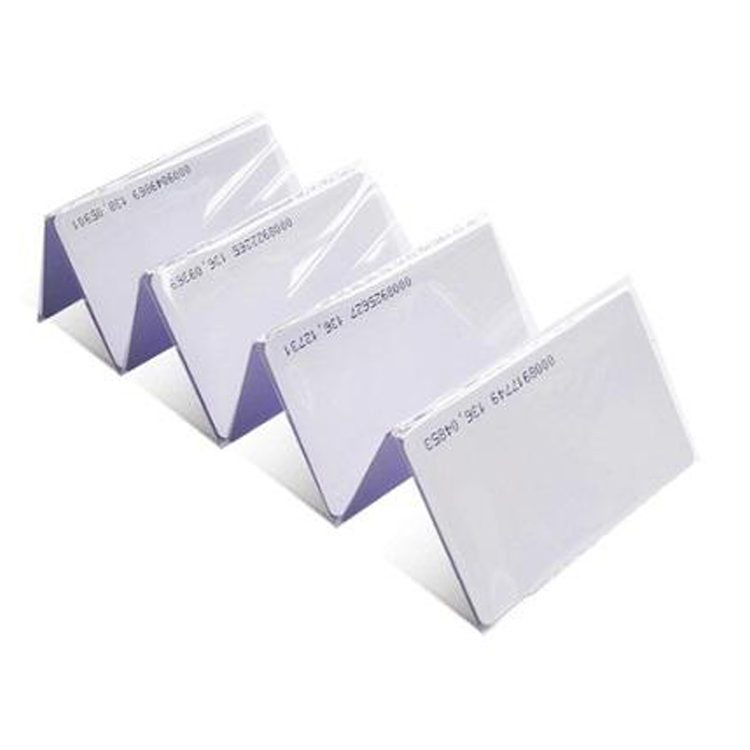
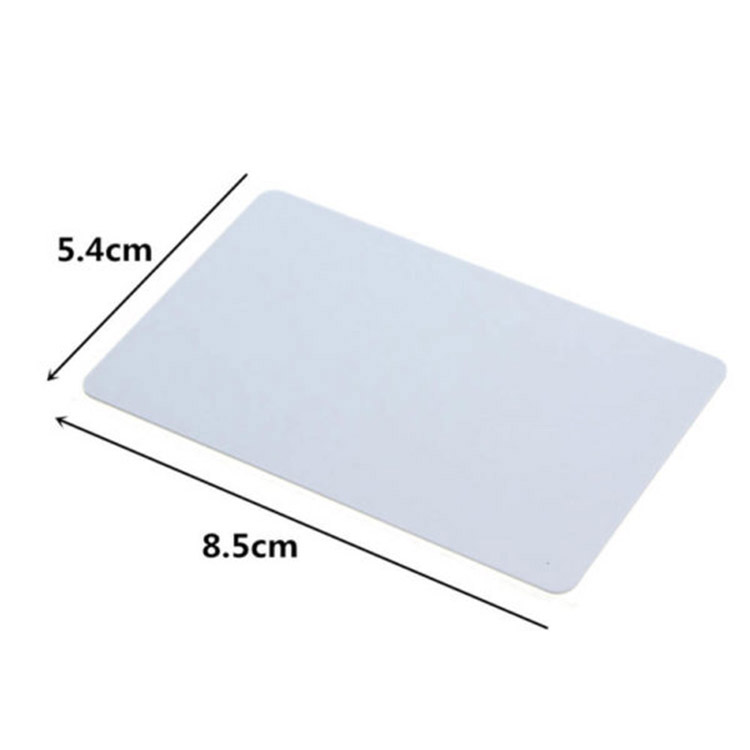
In terms of physical properties, the TK4100 RFID Card is small and exquisite, with a standard size of 85.6×53.98×0.8mm, which is easy to carry. Whether it is placed in a wallet or hung on a keychain, it will not bring any burden to the user. It is very durable, encapsulated with high-quality PVC material, with excellent waterproof and impact resistance. Whether in a humid environment or accidentally hit, it can work stably, and the data can be stored for up to 10 years, which can effectively reduce the replacement cost and management trouble caused by card damage.
In terms of functional characteristics, the TK4100 RFID Card also has outstanding performance. It supports a variety of personalized customization, and trademarks and IDs can be printed on the packaging to meet the needs of enterprises and institutions for brand display and information identification. For example, enterprises can print their logos on cards as employee work permits, which are both beautiful and practical; schools can print students’ names, classes, and other information on cards and use them as campus cards.
TK4100 RFID Card is a low-frequency smart card. When the tag is close to metal or liquid objects, it is less affected, which allows it to work stably in some complex environments. In some factory environments, there are many metal equipment, and the TK4100 RFID Card can realize equipment identification and management without interference; in logistics transportation, in the face of liquid environments, it can also ensure accurate reading of cargo information. Moreover, its corresponding low-frequency system is mature, and the matching reading and writing equipment is inexpensive. For large-scale enterprises and institutions, it can effectively reduce the procurement cost and use threshold.
TK4100 RFID Card Multiple Application Scenarios
The application scenarios of the TK4100 RFID Card are extremely wide, playing an important role in various fields, and bringing many conveniences and efficient experiences to people’s lives and work.
In the access control system, the TK4100 RFID Card is an important line of defense to ensure security. Many office buildings, communities, factories, and other places have adopted access control systems based on the TK4100 RFID Card. Employees or residents only need to bring the card close to the card reader, and the system can quickly identify their identity and determine whether they have permission to enter. In some high-end office buildings, only employees holding valid TK4100 RFID cards can enter the corresponding floor, which effectively prevents outsiders from breaking in at will and ensures the safety of the office environment. Moreover, the system can also record the entry and exit times of personnel, which is convenient for personnel management and safety tracing.
In the public transportation system, the TK4100 RFID Card realizes convenient payment for riding. Many cities’ public transportation cards adopt this technology. When passengers get on the bus, they only need to swipe the card on the card reader to complete the payment. There is no need to prepare for change, which greatly saves riding time and improves the efficiency of public transportation operations. In Beijing’s public transportation system, some of the widely used one-card passes adopt TK4100 RFID Card technology, providing convenient services for millions of passengers every day, effectively alleviating the payment pressure during peak riding hours, and improving the service quality of public transportation.
Campus one-card pass is a typical application of the TK4100 RFID Card in the field of education. On campus, students can use a TK4100 RFID Card campus one-card pass to realize multiple functions such as identity recognition, attendance management, book borrowing, and canteen consumption. When borrowing books in the library, you only need to swipe the card to quickly complete the borrowing registration; when dining in the canteen, you can also pay for meals by swiping the card, which is convenient and fast. A certain university has realized the informatization and intelligence of campus management by introducing the TK4100 RFID Card campus card system. Students do not need to carry multiple cards. With one card in hand, they can easily complete various campus affairs, which greatly improves the convenience and management efficiency of campus life.
In shopping malls and supermarkets, the TK4100 RFID Card is often used as a membership consumption card. After becoming a member, customers can get a TK4100 RFID Card membership card. When swiping the card during consumption, they can not only enjoy membership discounts but also earn points, which can be used to redeem gifts or deduct cash. This application is convenient for customers and also helps shopping malls and supermarkets carry out membership management and marketing activities. Supermarkets like Walmart can accurately analyze members’ consumption habits and preferences through the membership consumption card system, to launch targeted promotional activities and improve customer loyalty and consumption frequency.
In logistics management, the TK4100 RFID Card also plays an important role. During the transportation and storage of goods, the TK4100 RFID Card label is attached to the packaging of the goods. The card reader can quickly and accurately obtain information of the goods, including the name, quantity, origin, transportation route, etc., to achieve real-time tracking and management of the goods. In the express sorting center, RFID technology can quickly identify the package information, improve the sorting efficiency, and reduce the error rate. After a large logistics company adopted a logistics management system based on the TK4100 RFID Card, the sorting efficiency of goods increased by 30%, and the loss and misdelivery of goods were greatly reduced, which effectively reduced the logistics cost and improved the service quality.
Comparison with Other RFID Cards: Who is Better
In the large family of RFID cards, the TK4100 RFID Card occupies a unique position with its characteristics. Compared with other common RFID cards, each has its advantages and disadvantages and shows different applicability in different application scenarios.
From the frequency point of view, TK4100 works in the low-frequency band of 125KHz, while the common Mifare series cards mostly work in the high-frequency band of 13.56MHz. The advantage of low frequency is that it is less affected by metal and liquid interference. For example, in the metal equipment environment of the factory, TK4100 can work stably, but the reading distance is relatively short, generally within 10 cm; the reading distance of high-frequency cards can reach more than 10 cm. In some cases where there are requirements for reading distance, such as non-stop toll collection systems, high-frequency cards have more advantages.
- In terms of read and write functions, TK4100 is a read-only RFID card, and the card number is fixed at the factory and cannot be rewritten. In contrast, IC cards such as Mifare S50 have read and write functions and can write a large amount of data. They are suitable for scenarios where data needs to be updated frequently, such as e-wallets and membership card points systems. In the bus card system, Mifare S50 cards can record information such as balance and consumption records, and can be updated in real-time; while TK4100 can only be used for simple identity recognition, such as the identity verification link of bus cards, to confirm the legitimacy of the card.
- In terms of storage capacity, the storage capacity of TK4100 is generally between 125 bits and 512 bits, which is relatively small and is mainly used to store simple identity information. Ultra-high frequency RFID cards, such as cards with Alien H3 chips, have a storage capacity of up to 64 bytes or even higher and can store more complex data, such as detailed information of goods, logistics tracks, etc. In logistics and warehousing management, ultra-high frequency and large-capacity RFID cards can record cargo information more comprehensively.
- In terms of security, TK4100 has relatively low security because it has no encryption function, and its card number is publicly exposed and easy to copy. In contrast, CPU cards use highly encrypted chips and have a strong security authentication mechanism. They are often used in finance, identity authentication, and other fields with extremely high-security requirements, such as bank IC cards and second-generation ID cards, which effectively protect the user’s information security and financial security.
Price is also an important consideration. TK4100 has mature technology, a simple production process, and a relatively low price. Usually, the cost of each card is from a few cents to one yuan. For large-scale application scenarios, such as school attendance cards and corporate access cards, it can effectively reduce costs. Some high-end RFID cards, such as those with complex encryption functions and large-capacity storage, are relatively expensive and may reach several yuan or even higher.
TK4100 RFID Card has Unlimited Prospects
Looking to the future, with the continuous advancement and development of science and technology, the K4100 RFID Card is expected to show great application potential in more emerging fields, injecting new vitality into the development of various industries.
- In the field of smart homes, the TK4100 RFID Card may become an important identity recognition tool for smart door locks and smart home appliance control. Users only need to carry the card and approach the door lock or related equipment to achieve quick unlocking and device control, without the need for cumbersome password input or fingerprint recognition, bringing more convenience to daily life. When the user returns home, just put the TK4100 RFID Card close to the smart door lock, the door lock can quickly recognize the identity and open automatically. At the same time, the smart lights, air conditioners, and other equipment in the home can also automatically adjust to the appropriate state according to the user’s preferences, creating a more intelligent and personalized home living environment.
- In the medical field, the TK4100 RFID Card can be used for patient identification, medical equipment management, and drug traceability. By storing the patient’s basic information and medical records in the card, doctors can quickly obtain detailed information about the patient through the card reader during ward rounds or treatment, improving medical efficiency and accuracy. In terms of drug management, using the TK4100 RFID Card to track drugs can ensure the quality and safety of drugs and prevent counterfeit drugs from entering the market. Hospital pharmacies can quickly and accurately conduct drug inventory and inventory management by reading the RFID card information on the drug packaging to ensure the timely supply of drugs.
- In the agricultural field, the TK4100 RFID Card can also play a role. It can be used for agricultural product traceability. By attaching RFID tags to agricultural products, it records the information of each link such as planting, picking, transportation, and sales of agricultural products. Consumers can understand the source and quality of agricultural products by reading the card information, realizing full traceability from farmland to table, and ensuring food safety. In animal husbandry, wearing a TK4100 RFID Card on livestock can monitor the health status, growth environment, and other information of livestock in real time, provide data support for scientific breeding, and improve breeding efficiency.
From the perspective of technology upgrades, to improve the performance of the TK4100 RFID Card, improvements may be made in the future in terms of improving the reading distance and speed. By optimizing the antenna design and signal processing algorithm, the reading distance can break through the existing limitations and achieve rapid identification in a wider range. In some large warehousing and logistics centers, longer reading distances and faster reading speeds can improve the efficiency of inventory and sorting of goods and reduce the time and cost of manual operations.
Security is also an important direction for future technology upgrades of the f TK4100 RFID Card. With the continuous expansion of application scenarios, the requirements for card security are getting higher and higher. In the future, more advanced encryption technologies may be introduced, such as the preliminary application of quantum encryption algorithms, to enhance the confidentiality and integrity of card data, prevent data from being stolen or tampered with, and ensure that it can be more widely used in fields with extremely high-security requirements such as finance and identity authentication.