


With the continuous advancement of Internet of Things (IoT) technology, the application of NFC (Near Field Communication) tags has gradually penetrated into all walks of life. These small and efficient tags have been widely used in smart cards, item tracking, payment systems and other fields with their convenient wireless communication characteristics. However, when the tag needs to contact the metal surface, the signal of ordinary NFC tags may be seriously interfered, resulting in data loss or reading failure. In order to meet this challenge, anti-metal NFC tags came into being and became an ideal choice for efficient management of items in complex environments.

Definition and characteristics of anti-metal NFC tags
In short, anti-metal NFC tags are specially designed near-field communication tags that specifically solve the performance problems of ordinary NFC tags when applied on metal surfaces. Ordinary NFC tags are usually affected by the reflection and absorption of metal, resulting in unstable signal transmission or even failure to work properly. The anti-metal NFC tag uses innovative technology to enable it to maintain good communication effects in metal environments.
Anti-metal NFC tags usually consist of an embedded NFC chip, antenna and protective shielding layer. Its antenna and chip are carefully designed to adapt to the interference caused by metal surfaces. By adopting special materials and structural design, anti-metal NFC tags can not only avoid signal attenuation caused by metal, but also ensure stable reading on metal objects.
Working principle: How to deal with metal interference?
The working principle of NFC tags is to transmit data through electromagnetic waves. When the NFC tag is close to the NFC reader, an electromagnetic field is formed between the tag and the reader, and then the data is transmitted. However, the metal surface absorbs or reflects electromagnetic waves, causing signal attenuation, making ordinary tags unable to work properly.
In order to overcome this problem, several core technologies are used in the design of anti-metal NFC tags:
Shielding layer: A special shielding layer is usually added inside the tag to prevent metal from interfering with electromagnetic signals. This shielding layer can effectively prevent metal from absorbing and reflecting the tag signal, making data transmission more stable.
Special antenna design: Compared with ordinary NFC tags, the antenna of anti-metal NFC tags is optimized to maintain good working performance on metal surfaces and near metal objects.
Materials resistant to metal environments: Anti-metal tags usually use materials that can contact metal without interference, so that even in metal environments, the tags can ensure efficient communication.
These technologies enable anti-metal NFC tags to accurately transmit data on metal surfaces, meeting the needs of different industries for item tracking and management.
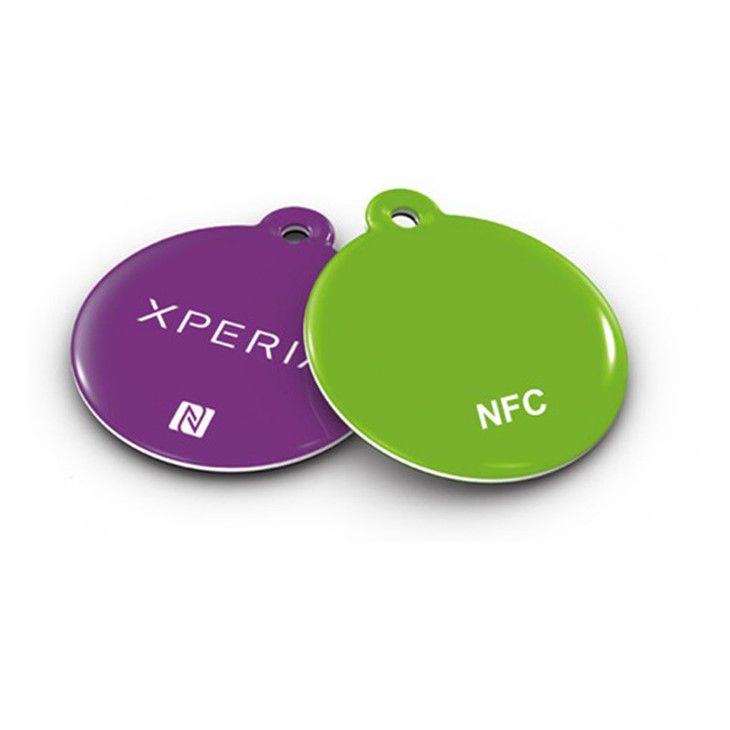
Main applications of anti-metal NFC tags
Due to their unique anti-interference capabilities, anti-metal NFC tags are widely used in many special environments. The following are some typical application scenarios:
Logistics and supply chain management: In the logistics industry, goods are often packaged in metal containers or may come into contact with metal objects during transportation. In such an environment, ordinary NFC tags are difficult to work properly, which may result in the inability to effectively track the status of goods. Anti-metal NFC tags can reliably transmit information in metal environments, providing accurate tracking solutions for logistics management, helping companies improve inventory management efficiency and transparency of goods tracking.
Industrial equipment and tool management: Many industrial equipment, machines and tools are made of metal, and ordinary NFC tags may lose their effectiveness on these metal surfaces. The emergence of anti-metal NFC tags makes equipment asset management more intelligent. Whether in factories, warehouses or construction sites, workers and managers can obtain real-time information such as the operating status and maintenance records of equipment by scanning tags to ensure efficient operation of equipment.
Automotive industry: In the field of automobile manufacturing and maintenance, the tracking and management of metal parts is crucial. Traditional tags cannot work on these parts, but anti-metal NFC tags can solve this problem. In the process of automobile production line, spare parts management, maintenance and inspection, etc., anti-metal NFC tags help enterprises improve traceability and ensure the efficiency and safety of production and maintenance processes.
Medical industry: Many medical devices, drugs and instruments in hospitals use metal materials. Anti-metal NFC tags can work accurately on the surface of these devices, which is helpful for asset management, equipment maintenance and drug tracking. In addition, this kind of tag can also be used for patient identity authentication, improving medical safety and management efficiency.
Smart home and Internet of Things: Modern smart home devices usually have more contact with metal surfaces, especially in smart home appliances and security systems, the use of ordinary NFC tags may be interfered. Anti-metal NFC tags can provide stable data transmission, ensure seamless connection between smart devices, and improve the intelligence level of home automation systems.
Advantages of anti-metal NFC tags
The successful application of anti-metal NFC tags in many fields is inseparable from its unique advantages:
High stability: Even in metal environments, anti-metal NFC tags can maintain stable performance to ensure the accuracy and real-time performance of data transmission.
Strong adaptability: This tag can adapt to various metal environments, including harsh conditions such as high temperature and humidity changes, and is widely used in multiple industries such as industry, logistics, and medical care.
Improve management efficiency: By applying anti-metal NFC tags, enterprises can achieve more accurate item tracking and asset management, greatly improve operational efficiency, and reduce human errors.
Reduce costs: Compared with other complex tracking technologies (such as GPS), anti-metal NFC tags not only have superior performance, but also relatively low cost. For companies with limited budgets, it is a cost-effective solution.
Future Outlook
With the continuous development of intelligent and IoT technologies, anti-metal NFC tags will play a greater role in more industries and applications. From smart logistics to industrial automation, to medical equipment management, the application of anti-metal NFC tags will continue to expand. In the future, with the advancement of technology, anti-metal NFC tags will be more miniaturized and functional, and may even be integrated with other IoT technologies (such as sensors and artificial intelligence) to promote more efficient and intelligent management systems.
Anti-metal NFC tags provide a perfect solution for many industries that need to track and manage items in metal environments. It not only solves the problem that traditional NFC tags cannot work properly on metal surfaces, but also greatly improves the efficiency and intelligence level of logistics management, equipment tracking, smart home and other fields. With the continuous advancement of technology, anti-metal NFC tags will continue to promote the digital transformation of various industries and bring more intelligent and efficient management models.