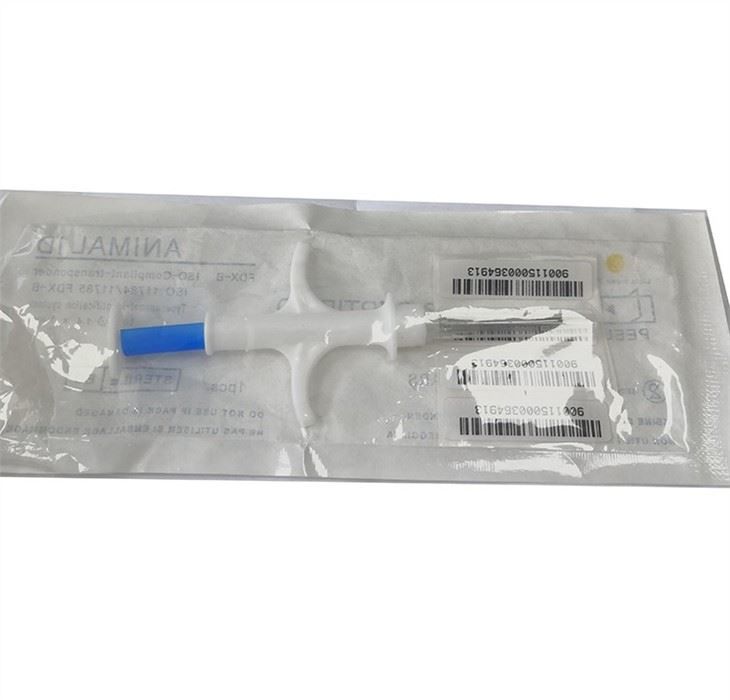

Produkter Beskrivelse
RFID animal glass tubes are usually made of glass or biocompatible materials, have a tiny size and a soft shell, so that they can be safely implanted in animals. The device contains an integrated circuit chip and a small antenna. The RFID chip stores a unique identification code that can be read when communicating with an RFID reader.
The process of implanting RFID animal glass tubes is usually done by a trained veterinarian or technician. Using a syringe, they implant glass RFID tubes into the animals, usually under the skin of the animals’ necks or backs. Once implanted, the presence of the RFID animal glass tube is almost imperceptible to the animal and causes no discomfort or pain.
RFID technology can communicate via radio waves, allowing readers to communicate wirelessly with implanted RFID animal glass tubes. When the reader approaches the location of the animal’s body, it emits a radio signal and receives a response signal emitted by the RFID chip. In this way, the reader can recognize and read the unique identification code stored in the RFID chip.
Products Advantage
One of the main advantages of RFID animal glass tubing is its durability. Once implanted in an animal, the RFID glass tube can exist for a long time and provide continuous identification and tracking functions. This makes it widely used in animal management, animal husbandry and scientific research, such as animal identification, vaccination records, behavioral research and population monitoring.
Another important advantage is the contactless nature of RFID technology. Compared with traditional identification methods, such as ear tags or ties, RFID animal glass tubes do not require physical contact to read information. This makes the identification process more convenient, fast and accurate, with less intervention and stress on the animal.
Hvordan bruger man det?
RFID (Radio Frequency Identification) animal syringe is a device that uses radio frequency identification technology to inject drugs or perform other related operations for animals. The following are the general steps to use RFID animal syringes:
Forberedelse:
Sørg for, at du har et dyr med en RFID-chip. Det er normalt en lille mikrochip, der implanteres under dyrets hud.
Make sure you have an RFID animal syringe. This is usually a handheld device that has a needle or syringe port for injecting the drug into the animal and can read information from an RFID chip.
Tjek sprøjten:
Sørg for, at sprøjten er opladet (hvis det er en genopladelig enhed), eller at der er sat nye batterier i (hvis det er en batteridrevet enhed).
Tjek displayet eller lyset på sprøjten for at sikre, at det fungerer.
Identificer dyr:
Placer RFID-dyresprøjten tæt på chipstedet på dyrets krop.
Aktivér RFID-læsefunktionen. Dette kan gøres ved at trykke på en knap på enheden eller ved at røre ved skærmen.
Når injektoren har aflæst dyrets RFID-chip, viser den relevante oplysninger om dyret, f.eks. navn, nummer osv.
For at injicere:
Bestem den nødvendige injektionsdosis og type af lægemiddel.
Stik nålen eller sprøjteporten ind under dyrets hud.
Tryk eller rør ved injektionsknappen på sprøjten for at injicere lægemidlet i dyret. Sørg for at følge den korrekte dosering og injektionsmetode.
Bemærk, at forskellige RFID-dyresprøjter kan have visse forskelle, så det er bedst at læse den relevante brugervejledning eller følge producentens anvisninger før brug. Vær også forsigtig, når du bruger RFID-dyresprøjter, og sørg for, at du har tilstrækkelig træning og erfaring til at sikre dine dyrs sikkerhed og velbefindende. Hvis det er nødvendigt, kan du søge dyrlæge eller professionel hjælp.
To sum up, RFID animal syringes have the advantages of high efficiency and speed, data management, accurate records, improved safety and batch management. They provide more convenient, accurate and efficient solutions for animal management and veterinary care.
Relaterede produkter