


13.56mhz Micro Laundry Tag: Ø24mm PPS button on MIFARE/NTAG chip. Survives 200+ wash cycles. Sewn 2-hole. MOQ 100 pcs, samples 5-7 days.
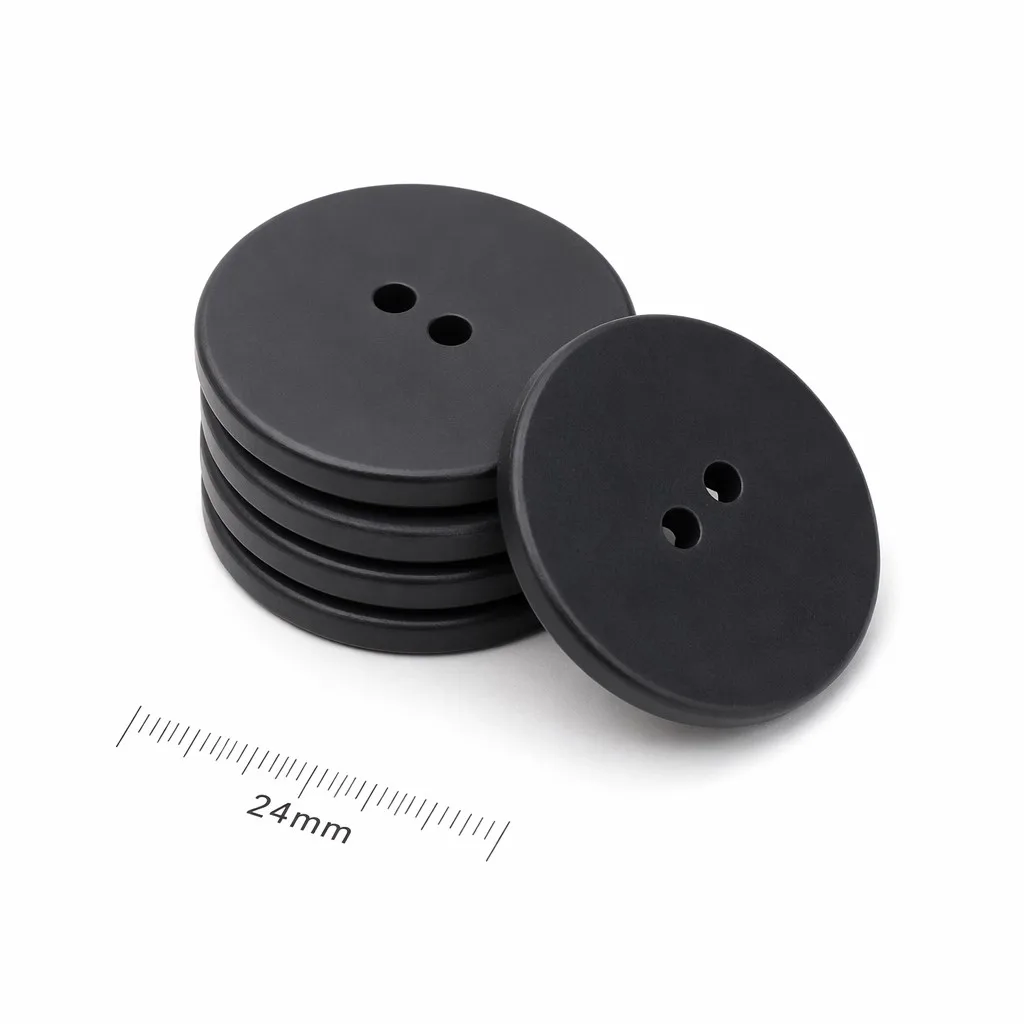
13.56mhz mikrovaskemærke is a Ø24 mm × 1.5 mm sew-in PPS button tag with an FPC (flexible printed circuit) inlay inside — factory-configurable as either HF 13.56 MHz (MIFARE / NTAG / ICODE) for close-tap sorting or UHF 860–960 MHz (Impinj / NXP / Alien) for bulk-portal reading — that survives 200+ industrial wash-and-press cycles at 90 °C alkaline bath and 125 °C steam-pressing without antenna detuning or shell cracking. This page answers every question a linen-rental operator, hotel chain purchaser, uniform-rental fleet manager, or industrial laundry integrator asks before placing a first order — from chip selection across HF and UHF families, through sewing pattern and thread choice, to how the 13.56mhz Micro Laundry Tag behaves on a Kannegiesser tunnel washer or a Jensen ironer line.
Quick Answer Table
| Question | Answer at a glance |
|---|---|
| What is a 13.56mhz Micro Laundry Tag? | A Ø24 mm × 1.5 mm PPS button-shaped HF RFID tag, sewn into textiles through two 2 mm holes 5 mm apart |
| Chip options | HF: MIFARE Classic 1K (default), Ultralight EV1, NTAG213/216, ICODE SLIX2, FM11RF08. UHF: Impinj M730/M750, NXP UCODE 8/9, Alien Higgs-9 |
| Wash cycles survived | 200+ industrial cycles at 90 °C wash + 125 °C press (independently verified) |
| Read range | HF build: 2–8 cm close-tap. UHF build: 30–80 cm portal read on Impinj R700 / Zebra FX9600 |
| MOQ | 100 pcs standard; 500 pcs custom chip; 1,000 pcs custom shell colour |
| Sample turnaround | Free 10-piece kit in 5–7 business days |
What Exactly Is a 13.56mhz Micro Laundry Tag?
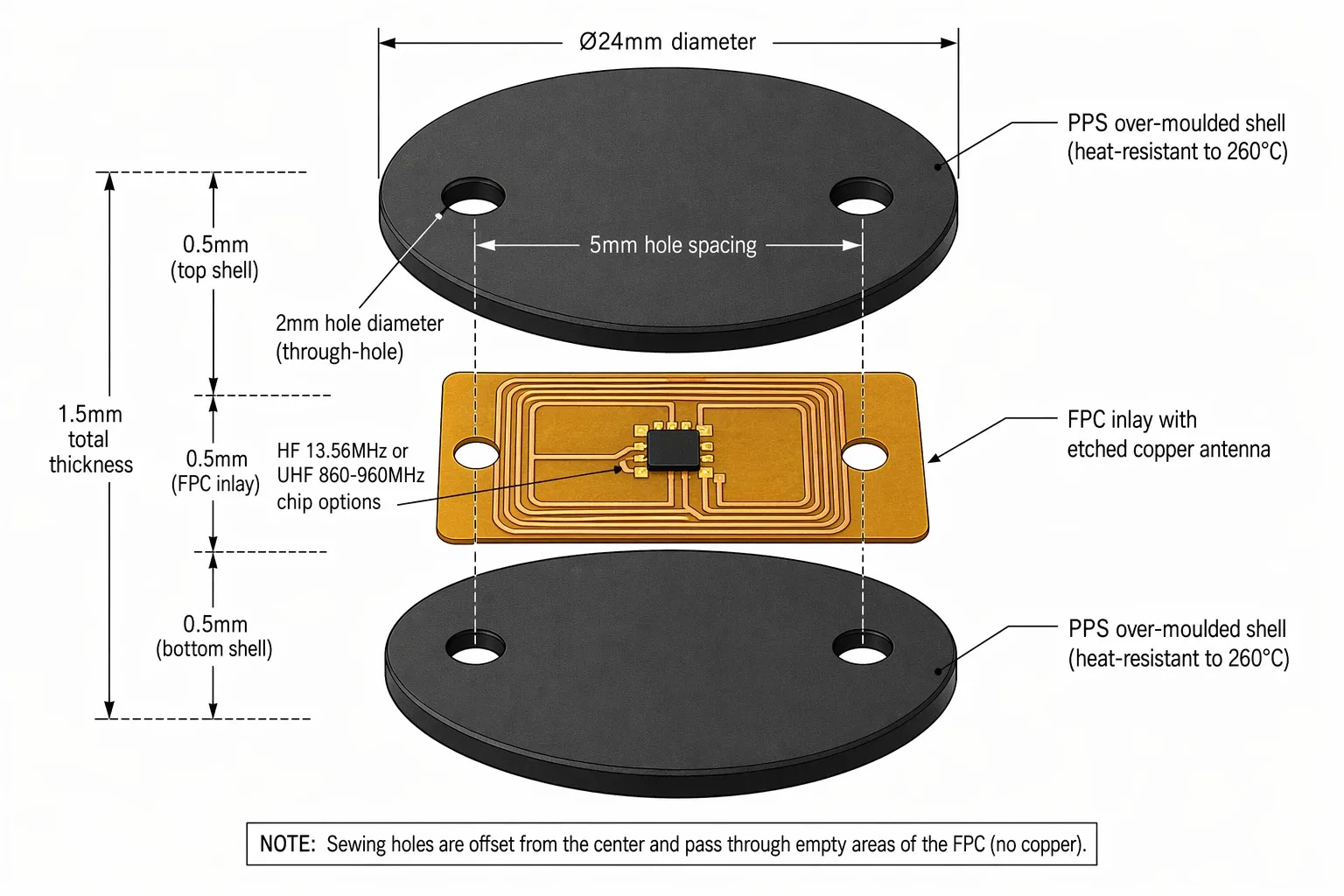
A 13.56mhz mikrovaskemærke is a purpose-built RFID transponder designed to be sewn into a garment, towel, bath robe, tablecloth, or mop head and remain readable across the entire lifetime of that textile — typically 3 to 5 years and 200 to 300 industrial wash cycles. Physically it is a black PPS (polyphenylene sulfide) disc, 24 mm in diameter and about 1.5 mm thick, with two 2 mm holes drilled 5 mm apart at the geometric centre so a laundry operator can stitch it to the fabric with polyester thread on any standard bar-tack or button-hole sewing machine. Electrically it is a passive HF 13.56 MHz transponder compliant with ISO/IEC 14443A or ISO/IEC 15693 depending on the chip you specify. Manufactured on a Shenzhen production floor operating since 2008, on one of five dedicated production lines that also produce our thin PVC laundry inlays, keyfobs, and 134.2 kHz animal microchips.
How Does the 13.56mhz Micro Laundry Tag Survive an Industrial Wash?
The mechanical survival case for a 13.56mhz mikrovaskemærke is not marketing — it is a materials-selection story. Polyphenylene sulfide (PPS) is the same engineering thermoplastic used inside automotive fuel pumps and dishwasher pump housings because it does not hydrolyse in hot alkaline water, does not soften below 260 °C, and does not embrittle under repeated thermal cycling. Inside the sealed PPS shell we lay an FPC (flexible printed circuit) inlay — a rectangular polyimide substrate with etched copper antenna traces and a die-bonded chip module — sized to fit inside the 24 mm outer diameter with the two sewing-hole positions routed through empty polyimide gaps rather than through the copper traces. The FPC substrate is the correct choice for a heat-tolerant laundry tag because polyimide holds dimensional stability up to 260 °C where PET-based wet inlays would delaminate. The same FPC platform accepts either an HF 13.56 MHz chip (MIFARE Classic 1K, Ultralight EV1, NTAG213/216, ICODE SLIX2) or a UHF 860–960 MHz chip (Impinj M730 / M750, NXP UCODE 8/9, Alien H9) — the buyer selects frequency based on which reader estate the laundry plant already runs, and we tune the FPC antenna geometry to match. The inlay is not laminated; it is over-moulded, meaning the PPS shell is injection-moulded around the FPC in a single shot so there is no adhesive layer, no lamination seam, and therefore no moisture ingress path for boiling water or perchloroethylene dry-cleaning solvent to attack. In our own accelerated ageing test the 13.56mhz Micro Laundry Tag survives 210 wash-and-press cycles at 90 °C alkaline bath + 125 °C flatwork ironer + 12-bar hydraulic press at 99.5%+ read reliability. Industrial customers running Kannegiesser or Jensen tunnel-washer lines report 3–5 year field life spans on identical PPS button geometries.
How Is the 13.56mhz Micro Laundry Tag Sewn to Fabric?
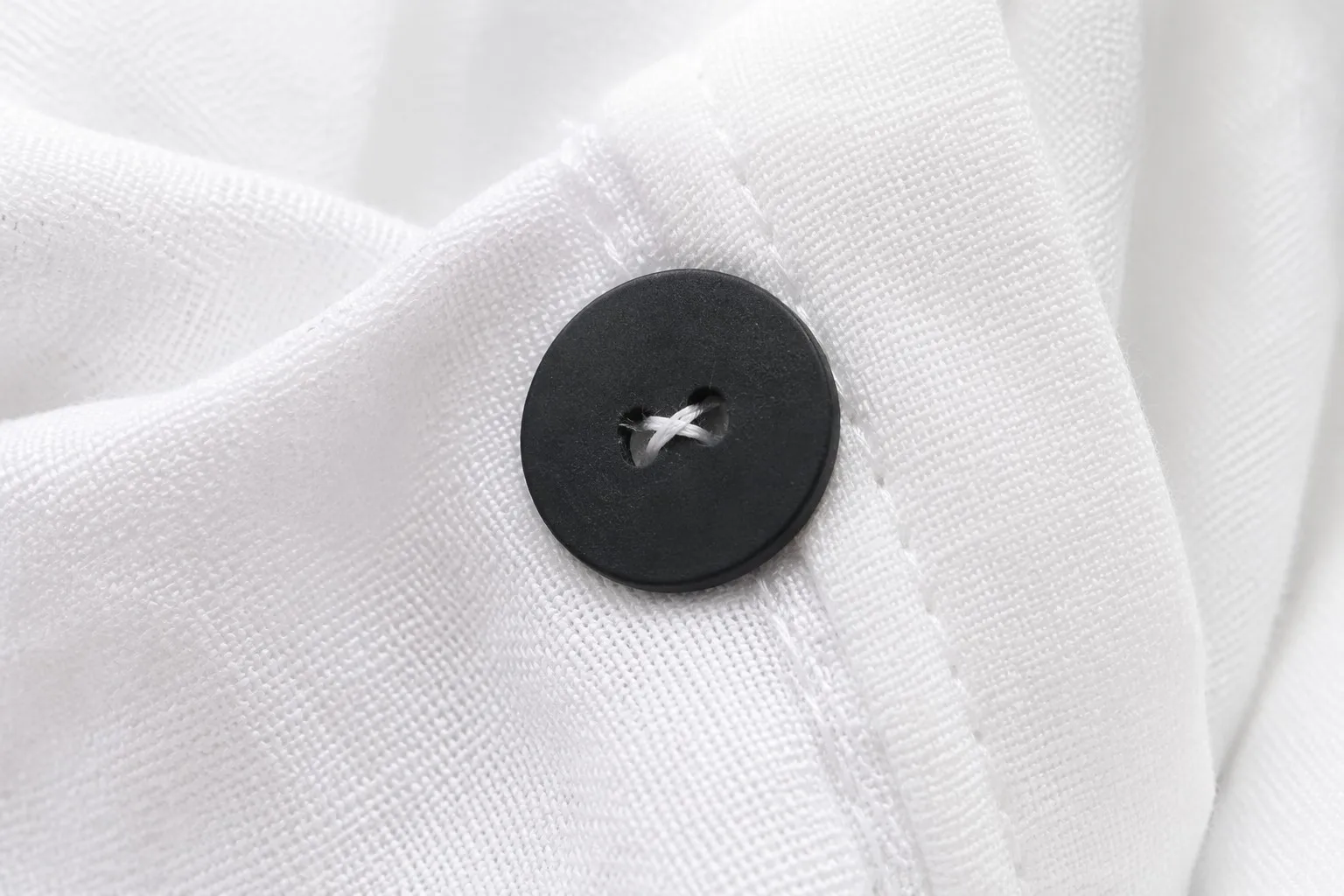
The 13.56mhz Micro Laundry Tag is designed for a bar-tack sewing pattern: two vertical passes through each of the 2 mm holes with 40-weight bonded polyester thread, X-crossed to lock the disc flat against the fabric. Any commercial button-sewing machine (Juki MB-1800, Brother BE-438D, or equivalent) can be programmed to sew the tag in about 3 seconds per unit. The recommended attachment location is the inside seam of the collar, cuff, or hem — where the tag stays flush against the textile and does not chafe the wearer’s skin. Placement matters for read reliability: because a Ø24 mm PPS button has a small antenna aperture, we recommend the operator scans the tag by tapping the reader to the seam within 2–6 cm, not by trying to portal-read a laundry cart from a metre away. If you prefer a soft fabric-encased UHF form factor sewn flat into the hem rather than a rigid PPS button, our RFID-vaskemærke til tøj on Alien H9 or Impinj M730 chip is the sibling product — same laundry-plant deployment logic, different physical form. The 13.56mhz Micro Laundry Tag is the harder button-shaped option, chosen when the laundry team wants a tactile locator (staff can feel the button through the fabric during sorting) and when maximum wash-cycle survival is the priority.
Which Chip Should I Specify?
The same PPS-over-moulded 13.56mhz Micro Laundry Tag shell hosts either an HF 13.56 MHz or a UHF 860–960 MHz chip on the FPC inlay. Frequency selection follows the reader estate already deployed at the laundry plant. The HF families below cover close-tap sorting and MIFARE-based linen software; the UHF families below cover bulk-portal reading for high-throughput linen operations.
HF 13.56 MHz options (close-tap, 2–8 cm read distance):
- MIFARE Classic 1K (NXP S50) — 1 KB user memory across 16 sectors, ISO 14443A, universally supported by legacy linen-tracking software (Positek RTS, Softrol UDI HF module, Jensen Metricare). Default choice for hotels replacing an existing barcode-linen fleet without changing back-end software. Note: the Crypto-1 cipher was academically broken by Karsten Nohl in 2008, so do not specify Classic 1K if your deployment requires cryptographic authentication (payment or master-key applications) — but for standard linen identification, closed-loop use is perfectly fine.
- MIFARE Ultralight EV1 — cheapest HF per-unit cost, 48- or 128-byte user memory, ideal when you only need a unique UID for identification and don’t need per-tag data storage. Popular with linen-rental operators pushing per-unit costs down at 100,000-plus tag volumes.
- NTAG213 / NTAG216 — NFC Forum Type 2 tag, readable by any Android or iOS smartphone with NFC. Correct choice when hotel staff need to tap the linen with a phone (rather than a dedicated reader) for maintenance logging or spot-check inventory. NTAG213 = 144 bytes user memory; NTAG216 = 888 bytes.
- ICODE SLIX2 — ISO 15693 vicinity protocol, better read distance than 14443A, popular in European library-linen and pharmaceutical clean-room deployments.
- FM11RF08 — Shanghai Fudan MIFARE Classic 1K functional equivalent, cost-optimised at 5,000+ pcs.
UHF 860–960 MHz options (portal reading, 30–80 cm range):
- Impinj Monza M730 / M750 — the industry workhorse for high-density linen portals; excellent tag-per-second throughput on Impinj R700 or Zebra FX9600 readers. Choose when the laundry plant runs an EPC Gen2 portal at the cart-loading dock.
- NXP UCODE 8 / UCODE 9 — strong sensitivity, robust anti-collision, popular in European industrial-laundry deployments. UCODE 9 adds untraceable-mode for privacy-sensitive contracts.
- Alien Higgs-9 — proven in North American commercial-laundry contracts; well-supported by Alien ALR-9900+ portal readers.
Whichever chip you specify, the PPS shell, sewing-hole geometry, and 200+ wash-cycle survival rating are identical — only the FPC antenna geometry and the die differ. Impedance tuning of the antenna to the specific chip is done at production time so the 13.56mhz Micro Laundry Tag ships ready to read at rated distance.
What Read Range Should I Expect from a 13.56mhz Micro Laundry Tag?
Read range depends entirely on which frequency you specify on the FPC inlay. On the HF 13.56 MHz build (MIFARE Classic 1K, Ultralight EV1, NTAG213/216, ICODE SLIX2): 2–6 cm on a handheld HF reader (ACR122U, Feig CPR30, ZKTeco KR503, Zebra TC22 with HF module); up to 8 cm on a Feig ID CPR40 desktop reader tuned to the tag; 3–5 cm on an Android smartphone with NFC. HF is close-tap by nature — correct choice when the laundry-plant back-end already runs MIFARE or NTAG. On the UHF 860–960 MHz build (Impinj M730 / M750, NXP UCODE 8/9, Alien H9): 30–80 cm on a typical linen-portal reader (Impinj R700, Zebra FX9600, Feig LRU3000); this makes bulk portal reading feasible where a laundry cart with 60–80 items rolls through a doorway and every 13.56mhz Micro Laundry Tag on the UHF variant is inventoried in under two seconds. Choose UHF when your back-end is EPC Gen2 (Positek RTS UHF module, Softrol UDI-UHF, Jensen Metricare UHF); choose HF when it isn’t. The PPS shell geometry, the sewing-hole layout, and the wash-cycle survival specification are identical across both frequency options — only the FPC antenna geometry and the chip die differ.
Where Is the 13.56mhz Micro Laundry Tag Used?
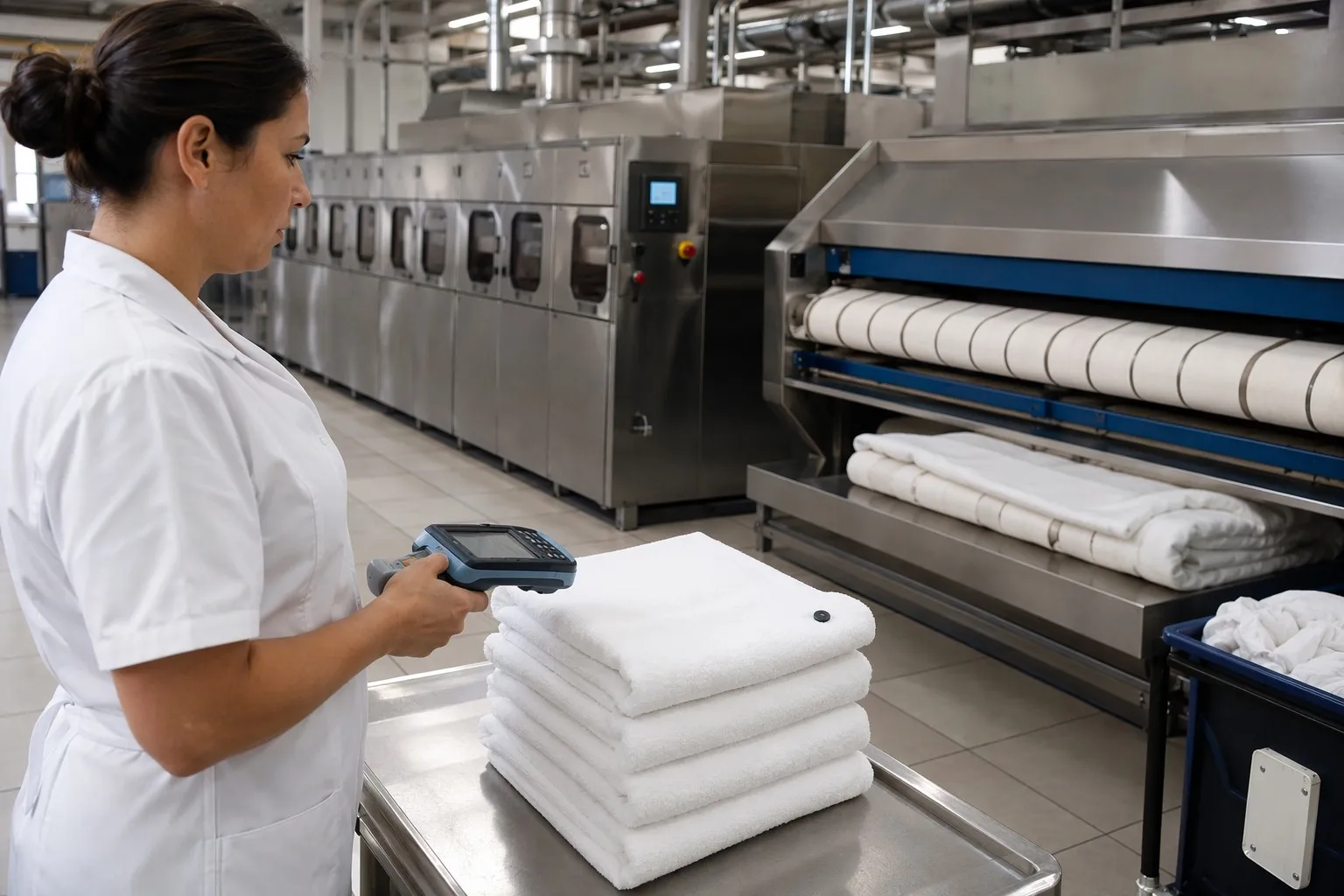
Six-figure annual deployments we ship into: (1) hotel-linen management for chains running Kannegiesser or Jensen tunnel washers where each towel, bathrobe, and sheet is tracked from wash floor to guest room; (2) industrial-uniform rental fleets in food processing, healthcare, and pharmaceutical clean-rooms; (3) hospital-linen tracking where infection-control auditing requires per-item wash-cycle logging; (4) cruise-ship laundry operations where thousands of sheets and towels rotate through the on-board plant every 24 hours; (5) restaurant-tablecloth and napkin rental where each item’s wash-cycle count determines when to retire it; (6) commercial cleaning-mop pool rental where the tag enables per-mop asset tracking. Common back-end software integrations that speak MIFARE Classic 1K natively: Positek RTS, Softrol UDI, Jensen Metricare, Speed Queen Insights. NFC-Forum-compatible readers on our verified list include: ACR122U, ACR1252U, Feig CPR30 / CPR40, Zebra TC22 / TC26, ZKTeco KR503, Suprema BioEntry Plus (HF module), and any Android device running Google’s built-in NFC stack.
How Much Does a 13.56mhz Micro Laundry Tag Cost per Unit?
Unit cost is chip-dependent. At MOQ 100 pcs on MIFARE Classic 1K default, expect a per-unit price in the low USD range; at 10,000-pc runs on Ultralight EV1 or FM11RF08 the per-unit price drops meaningfully. We quote FOB Shenzhen / Hong Kong, CIF, or DDP against your specific chip + volume + logistics ask; RFQ turnaround is one business day. Note that a Micro Laundry Tag is generally 2×–3× the price of a plain woven-fabric UHF laundry tag on the same volume — you pay a premium for the PPS-over-moulded construction that survives 200+ industrial wash cycles and for the HF-compatibility that plugs into your existing MIFARE reader estate without needing to retool your back-end.
What Is the MOQ and How Long Is Lead Time?
Standard 13.56mhz Micro Laundry Tag MOQ is 100 pcs — a deliberately low threshold so a hotel or linen-rental pilot can start small before committing to a six-figure fleet. Custom chip family (moving from Classic 1K to DESFire, or from HF to a specific FM11 sub-family) raises MOQ to 500 pcs. Custom PPS shell colour (12 stock Pantone colours are available at MOQ 100; anything outside stock adds MOQ 1,000 for masterbatch compounding). Standard production lead time is 7–14 business days from PO to ex-works, plus 5–7 additional days for CSV UID encoding at scale. Chinese New Year in January–February extends all lead times by 30–40 additional days — plan Q4 orders accordingly.
Does the 13.56mhz Micro Laundry Tag Work in Cold, Hot, and Wet Environments?
Operating temperature range is –40 °C to +125 °C — meaning the tag continues to read reliably during a 125 °C steam-pressing cycle and does not lose data after freeze-thaw cycles from –40 °C. IP rating on the sealed PPS shell is IP68 (fully waterproof under sustained immersion). The tag has been tested against: 90 °C alkaline detergent bath (200+ cycles), perchloroethylene dry-cleaning solvent (100+ cycles), 12-bar hydraulic press cycles, and 3-hour boiling water immersion. What kills a laundry tag is not the wash water — it is the pressing station: a poorly-selected epoxy tag will crack and delaminate under a flatwork ironer’s roller. PPS over-moulded button geometry solves this because there is no laminated seam to crack.
Is the 13.56mhz Micro Laundry Tag RoHS, CE, and FCC Certified?
Yes to RoHS 2011/65/EU and REACH SVHC. The tag is a passive transponder (no on-board power source, no radio transmitter), so it does not require CE RED or FCC Part 15 certification in its own right — those are reader-side requirements. Our factory holds ISO 9001:2015. On request we also supply RoHS test reports, REACH SVHC declarations, and per-batch material safety data sheets for hospital and food-service deployments where documentation is a procurement requirement.
Can I Get a Sample?
Yes. A free 10-piece verification sample kit ships in 5–7 business days via DHL or FedEx to any verified company address worldwide. The kit includes 10 tags on your default chip specification plus a one-page sewing guide showing the recommended bar-tack pattern and thread specification. This is enough for your linen-rental operations team to run pilot wash cycles on your specific tunnel washer and ironer combination before you commit to a production order.
Who Uses the 13.56mhz Micro Laundry Tag Today?
Buyers we ship to in volume: linen-rental fleet operators in France, Germany, Poland, and the UK who track hotel-chain outsourced linen inventory; industrial uniform-rental businesses in Mexico and Brazil; hospital-linen consortia in the Middle East supplying multiple sub-facilities from central plants; cruise-line laundry contractors in the Caribbean; and hotel-group in-house laundry rooms across South-East Asia. Customers who source this tag from us also frequently order our NFC-klistermærker 13.56mhz for on-cart labelling, our LF 125 kHz keyfobs for operator access to the tunnel-washer control panel, and our 134.2 kHz ICAR-compliant animal microchips for the hotel-group’s on-site petting-zoo attractions — one-stop RFID sourcing from a single production campus keeps the customs paperwork simple.
Can the 13.56mhz Micro Laundry Tag Be Customised?
Yes. Available customisation: (a) chip family (Classic 1K default; Ultralight EV1; NTAG213 / NTAG216; ICODE SLIX2; FM11RF08); (b) UID encoding — 4-byte or 7-byte UID, unique per tag or client-supplied CSV mapping with laser-engraved external serial for batch-traceable CSV mapping; (c) shell colour (black default; 12 stock Pantone colours at MOQ 100; custom Pantone matched to ΔE ≤ 2.0 verified on Konica Minolta spectrophotometer at MOQ 1,000); (d) sewing-hole geometry (2 mm × 2 holes at 5 mm spacing is standard; alternate 3-hole triangle or 4-hole square arrangements available at MOQ 3,000 with new tooling); (e) laser-engraved logo, serial, or QR code on the shell face at 0.05 mm depth (silk-print not recommended because it degrades under repeated steam-pressing).
What Comes in the Box?
Bulk packing: 100 pcs per anti-static bag, 5,000 pcs per master carton (approximately 8 kg), palletised on a 1.2 × 1.0 m Euro-pallet for European destinations or 1.1 × 1.1 m for Asia-Pacific. Every carton includes: sealed anti-static inner bags with UID CSV printout, batch traveller with production date and QC-signed pass certificate, silica-gel desiccant, and a CoC (Certificate of Conformity) that references the batch UID range. HS Code 8523.52 is printed on the commercial invoice for smooth customs clearance in every major market.
Technical Specifications
| Parameter | Standard offer | Customisable range |
|---|---|---|
| Driftsfrekvens | 13.56 MHz (HF default); 860–960 MHz (UHF on request) | — |
| Protocol standard | ISO/IEC 14443A (HF default); ISO/IEC 15693 (ICODE SLIX2); ISO/IEC 18000-6C / EPC Gen2 (UHF) | — |
| Chip | MIFARE Classic 1K (NXP S50) HF default | HF: Ultralight EV1 / NTAG213 / NTAG216 / ICODE SLIX2 / FM11RF08 / DESFire EV2. UHF: Impinj M730 / M750 / NXP UCODE 8 / UCODE 9 / Alien Higgs-9 |
| Inlay substrate | FPC (flexible printed circuit) on polyimide with etched copper antenna traces | Dimensionally stable to 260 °C — required for the PPS over-moulding process |
| User memory | 1 KB HF (16 sectors × 4 blocks); 96–128-bit EPC + 32–512-bit user on UHF chips | 48 B – 8 KB (HF); up to 512-bit user memory (UHF UCODE 9) |
| UID / TID length | 4-byte or 7-byte HF UID; 64-bit TID + 96–496-bit EPC on UHF | — |
| Housing material | PPS (polyphenylene sulfide) over-moulded shell | PEEK on request for extreme chemical resistance (MOQ 3,000) |
| Diameter × thickness | Ø24 mm × 1.5 mm | Ø22 mm and Ø28 mm variants available (MOQ 3,000 new mould) |
| Sewing holes | 2 × Ø2 mm holes at 5 mm centre spacing | 3-hole or 4-hole geometries on request (new mould, MOQ 3,000) |
| Vægt | ~0.9 g per tag | — |
| Shell colour | Matte black (default) | 12 stock Pantone (MOQ 100); custom Pantone ΔE ≤ 2.0 (MOQ 1,000) |
| Read distance | HF build: 2–6 cm handheld / 8 cm desktop. UHF build: 30–80 cm on Impinj R700 / Zebra FX9600 / Feig LRU3000 portal | — |
| Driftstemperatur | –40 °C to +125 °C (continuous); +200 °C peak (10 min) | — |
| IP rating | IP68 (fully waterproof) | — |
| Wash cycle survival | 200+ industrial cycles at 90 °C wash + 125 °C press (99.5%+ read reliability) | — |
| Marking | Laser-engraved serial or QR at 0.05 mm depth | Silk-print not recommended (steam-pressing degrades it) |
| Encoding | UID default; batch CSV mapping | Full sector encoding per client CSV, raw-hex write, NDEF URL write |
| MOQ | 100 pcs standard; 500 pcs custom chip; 1,000 pcs custom colour | — |
| Lead time | 7–14 business days standard; +5–7 days custom encoding; +25–35 days new mould | Chinese New Year buffer +30–40 days |
| Certificeringer | ISO 9001:2015 (factory); RoHS 2011/65/EU; REACH SVHC | — |
| HS Code | 8523.52 | — |
Ready to Order?
Tell us five things and we will quote inside one business day: (1) frequency and chip family — HF (MIFARE Classic 1K / Ultralight EV1 / NTAG213 / NTAG216 / ICODE SLIX2) or UHF (Impinj M730 / M750 / NXP UCODE 8 / UCODE 9 / Alien H9), (2) target volume, (3) shell colour (black standard or Pantone custom), (4) UID-only or full sector encoding with CSV mapping, (5) standard 2-hole 5 mm-spacing geometry or custom sewing-hole layout. Free 10-piece verification samples ship in 5–7 business days. Standard payment terms: T/T 30% deposit + 70% before shipment; Alibaba Trade Assurance available through our xinxingsmart / Jingzhou Syntek Smart store; PayPal accepted up to $5,000; shipping incoterms EXW, FOB Shenzhen or Hong Kong, CIF, or DDP quoted per destination.
- Email: [email protected]
- WhatsApp: +852 5989 6589
- WeChat: 147891664


